The General Court’s judgment confirms its willingness to reassess the calculation of a fine by the Commission, with a reduction of almost 40%.
What has the General Court decided?
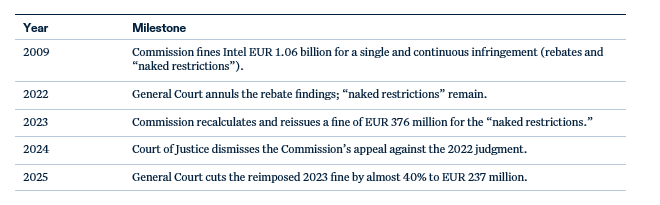
On 10 December 2025, the General Court handed down its ruling in Intel Corporation v Commission (Case T-1129/23). This judgment is the latest step in Intel’s long-running legal battle. In 2009, the European Commission (the “Commission”) fined Intel EUR 1.06 billion for a single and continuous infringement based on loyalty rebates and “naked restrictions” imposed on HP, Acer and Lenovo. The “naked restrictions” were direct obligations on Intel’s customers to delay, limit or stop selling the CPU‑based products of rival AMD.
In 2022, the General Court annulled the Commission’s findings on rebates but left standing the findings on naked restrictions. In 2024, the Court of Justice of the European Union (“CJEU”) dismissed the Commission’s appeal against that annulment (as we reported). In 2023, the Commission re‑imposed a fine, recalculated to relate only to the naked restrictions. Intel sought annulment of the second fine (but did not appeal the naked restriction findings). In this latest judgment, the General Court has reduced the amount of the fine, but otherwise dismissed the action.
Key points
- Findings on naked restrictions. The findings on the naked restrictions in the 2009 decision became final because Intel did not appeal them. The General Court ruled that in reassessing the fine for those infringements, the Commission did not need to repeat the procedural steps for establishing an infringement (redefining the infringement, re‑establishing jurisdiction or issuing a new statement of objections). Intel fully understood the case against it and the reasoning and evidence underpinning the infringement finding.
- Calculation of the fine. The General Court agreed that, “despite the amount of the fine set out in the contested decision being lawful, it is nevertheless possible, fair and appropriate to take account of other parameters, relating to both the duration of the infringement and its gravity”:
- Duration of the infringement. The General Court ruled that the Commission should have given more importance to the gap in the duration of the infringement and the number of affected sales. In particular, a 12-month gap separated the naked restrictions imposed on HP from those imposed on Lenovo. The Commission had taken this into account to some extent, but the General Court considered that “it is appropriate to accentuate the weighing of that gap.”
- Gravity of the infringement. The number of units affected by the infringement in Europe was modest and the material scope of the infringement is more limited than it was in the 2009 decision. A lower weighting should have been given to the gravity of the infringement.
- System of remedies. Intel alleged a violation of the requirement under Article 47 of the Charter of Fundamental Rights to adjudicate cases within a reasonable time. The General Court ruled that this argument was not relevant to the amount of the penalty. It confirmed that parties are free to bring an action for damages if loss has been suffered as a result of a court’s delay.
Key takeaways for businesses?
- Litigation can materially reduce fines. Once again, the General Court has confirmed that it is often financially worthwhile to challenge the penalty resulting from an infringement:
- While it is unusual to see a Commission decision fully annulled, it is not uncommon for the General Court to find certain elements leading to reductions in the amount of the fines.
- In Google Android (2022), the General Court reduced the fine of EUR 4.3 billion by EUR 200 million. Recently (2025), the General Court reduced Credit Suisse’s fine to EUR 29 million from 83.2 million. Research from 2017 found that almost 25% of appeals before the General Court (in competition proceedings) led to a reduction in the amount of fines.
- Courts have broad discretion to amend Commission decisions on the level of a penalty. Even when the Commission applies a correct methodology, the General Court may use its jurisdiction to adjust the amount for fairness and proportionality – for example, to weigh gaps in duration or the modest scale of affected sales.
- Guidelines on Article 102 awaited. This judgment did not consider the substantive assessment of the naked restriction abuses but Intel’s legal battle as a whole is very likely to feed into the Commission’s planned Article 102 guidelines on exclusionary abuses. The Commission intends to publish the long-awaited guidelines soon.
Case timeline at a glance
 |
* * *
Related Insights