
The UK Business, Innovation, Science and Trade Committee issued two reports last week: “China and the UK economy: the case for risk-managed growth” (“China Report”) on 2 November 2026, and “Critical minerals” (“Critical Minerals Report”) on 5 November 2026. The China Report calls on the government to design a framework for “risk-managed growth” with China. The Critical Minerals Report reinforces that security of supply of critical minerals is a matter of national and economic security, in line with the trend across foreign investment screening regimes in many jurisdictions, including the UK’s National Security and Investment Act 2021 (“NSIA”), review by the Committee on Foreign Investment in the United States (“CFIUS”) and national FDI regimes around the EU.
Key Takeaways
-
The China Report finds that the UK Government has not delivered on its 2024 promise of a strategic, long-term, consistent approach to China, and that its record of decision making has been characterised by “reactivity, inconsistency, and opacity”.
-
It recommends, amongst other things:
-
A “traffic light” risk framework of red (off limits), amber (permitted subject to risk mitigations) and green (permitted) zones for economic engagement with China;
-
That the UK Government insist on fair trade, the strengthening of trade remedies and reform of procurement to enable British firms to compete on a level playing field. It should prevent the transfer of sensitive technologies and data to China by better resourcing the UK’s research security apparatus, banning high risk connected tech from UK critical national infrastructure and strengthening the regulation of data traffic between connected vehicles in the UK and foreign entities;
-
Updating the NSIA to give ongoing oversight of foreign ownership of, or control over, strategic entities and assets, including a power to review ownership where material circumstances (including the national security situation) change;
-
Amending section 54 NSIA so that the Government can share more information on screening decisions with Parliament. The Government has resisted similar calls since the inception of the regime on the basis that Parliament’s role in scrutinising individual case is exceptional rather than routine.
-
-
The Critical Minerals Report finds that the UK “is now dangerously dependent on supply chains that are dominated by China” and calls for the UK Government to “precision de-risk” UK critical mineral supply chains.
-
The Critical Minerals Report notes that China has demonstrated its willingness to use its dominant position in critical mineral supply chains, in particular processing, as a geopolitical weapon. In response, allied countries have introduced measures to secure supplies for their own industries. The UK faces pressure from both directions: exposure to economic coercion arising from concentrated supply chains, and increasing competition from partners seeking to secure access to critical minerals for their domestic industry.
-
The Critical Minerals Report’s recommendations most relevant to dealmakers are:
-
Create a Critical Minerals Finance Facility, bringing together the UK’s public finance institutions (including domestic, export and overseas development finance bodies) to finance strategic projects through equity, loans, long-term offtake agreements and price floors – mechanisms already being deployed by other governments. Individual UK finance bodies have previously supported UK critical mineral sources including tungsten (Tungsten West, 2026), tin (Cornish Metals, 2025 and 2026) and lithium (Cornish Lithium, 2023). Direct state investment is not proposed (although the UK Government has procured offtake rights in relation to some projects financed by UK finance bodies) and has not been a condition of NSIA clearances to date (and would be a radical step).
-
Establish “buyers” clubs with G7, EU and other allies to aggregate demand, jointly finance projects (for example, sharing the costs of new mines and smelters – a single US rare earth magnet facility required USD 1.25 billion of investment) and to secure offtake.
-
Publish lists of desired “sovereign capabilities”, critical mineral dependencies and minerals to be sourced domestically. These would crystallise economic security sensitivities and inform NSIA review of deals touching those areas. The Critical Minerals Report also recommends mapping UK workforce / skills requirements, which can be an area of focus for NSIA remedies.
-
Introduce procurement preference for firms sourcing from domestic and allied sources, with large-contract suppliers required to reduce exposure to high-risk jurisdictions, making supply chain origin a value driver in diligence (with echoes of the EU’s “European preference” strategy, discussed in our client memo). The US, for example, has offered tax credits to firms sourcing minerals domestically or from partners.
-
-
The UK Government is under no obligation to act on the committee’s recommendations but aims to respond within two months. With continued pressure from China, the two Reports will likely receive close attention. The Government did not accept any NSIA reform recommendations made by a 2025 report on economic security (discussed in our client memo).
The international context for critical minerals
Share of refined material production by country with the top producer’s % share
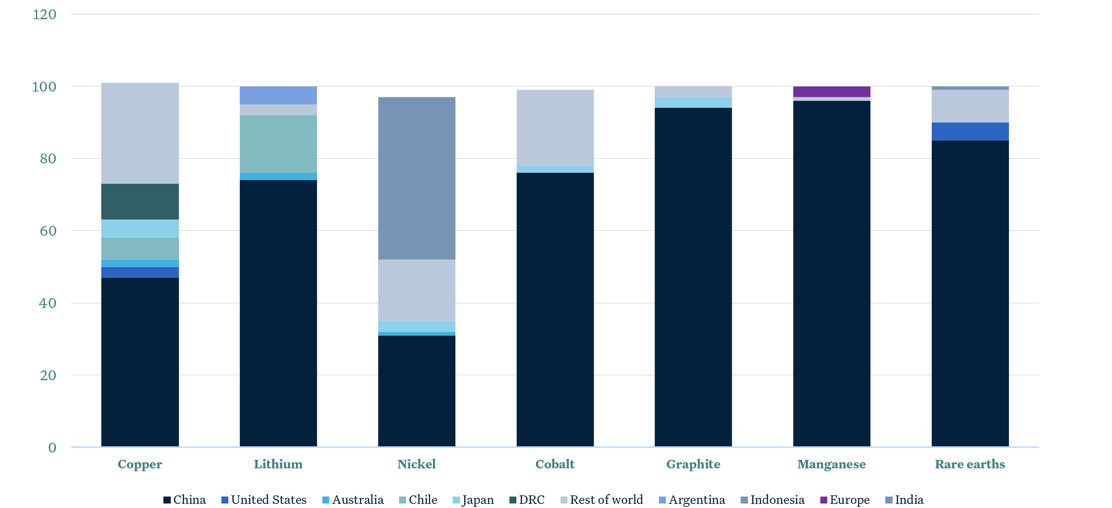
Source: IEA, Global Critical Minerals Outlook 2026: Market overview
China dominates critical minerals supply chains. It is the dominant refiner for 19 of 20 strategic minerals analysed in an International Energy Agency report, with shares over 90% for gallium, graphite, manganese and rare earths. Commentators have noted that it has withheld supply or flooded the market when competitors invest, pushing prices below economic levels. For example, global lithium prices fell by over 85% between December 2022 and mid-2025, while oversupply of nickel and cobalt is reported to have led to the closure of operations in Australia, New Caledonia and the US. China has also imposed export controls on rare earths, disrupting supply to manufacturers in the US, Japan and Europe.
Faced with China’s ability to leverage its strength for geopolitical advantage, other jurisdictions are taking steps to boost supply chain security and diversify sources of critical minerals. In the EU, the 2024 Critical Raw Materials Act (“CRMA”) establishes measures to strengthen the EU’s capacity and diversity of supply for critical raw materials. Its objective is that by 2030 EU capacity meets at least 10% of its annual consumption for extraction, 40% for processing, and 25% for recycling of strategic raw materials.
In the US, the Administration concluded in January 2026 that imports of processed critical minerals could potentially constitute a threat to US national security but, rather than imposing tariffs, the Administration directed negotiations with trading partners, including on price floors. It has also launched “Project Vault”, a USD 10 billion strategic critical minerals reserve, has taken equity stakes in critical minerals companies and restricted exports of certain recyclable critical materials. The UK has joined the US-led Forum on Resource Geostrategic Engagement alongside Canada, Australia, Japan and other allied nations.
Critical minerals in regulatory review
Critical minerals are included in the UK NSIA mandatory notification sectors. Activities such as extraction, refinement, processing, production and end-of-life recovery currently fall within the “advanced materials” sector definition. They are due to be carved out into a standalone mandatory notification sector (as reported in our client memo), although implementing legislation has not, as yet, been tabled. According to the Government’s Annual Report, in the 12 months to end March 2026, transactions involving high-value advanced materials were subject to the greatest level of intervention by the UK Government under the NSIA (see our client memo).
Critical minerals are also on the radar of other regulators. The recently revised EU FDI Screening Regulation (see our client memo) explicitly mandates Member States to screen foreign investments in critical raw materials and minerals on public order and security grounds. In the US, critical minerals are often within CFIUS’s core focus, which under the America First Investment Policy is seeking to expedite reviews for allied investors while intensifying scrutiny of investment from China (see our client memo).
Scrutiny of critical mineral supply is also not limited to FDI screening. For example, the EU Commission opened an in-depth investigation (which is ongoing) into MMG’s acquisition of Anglo American’s Brazilian nickel business, over concerns that MMG could divert low-carbon ferronickel supply away from European markets toward China. The Commission’s proposed revised draft Merger Guidelines expressly introduce resilience and security of supply as factors that could be relevant to merger control assessment (see our client memo). The inclusion of these broader policy goals alongside traditional antitrust assessment signals the growing reach of merger control into industrial strategy and economic security, blurring the boundary between FDI screening and merger control.
Investors should be aware that transactions involving critical minerals are likely to face close regulatory scrutiny, and take steps to identify and address any potential national and economic security risks at the outset of transaction planning and to engage with screening authorities and interested government departments to smooth review processes.
* * *
Related Insights

