
On November 13, 2026, the Securities and Exchange Commission(the “SEC” or “Commission”) proposed amendments (Release No. 33-11455) that would significantly rewrite Item 402 of Regulation S-K, the rule that governs executive and director compensation disclosure.
The proposed amendments would replace the current prescriptive requirements with a principles-based approach and refocus disclosure on information material to investors. The proposed amendments would limit the named executive officers (“NEOs”) covered by executive compensation disclosure rules to individuals who served as the registrant’s principal executive officer (“PEO”) and principal financial officer (“PFO”) during the applicable fiscal year, replace the Summary Compensation Table and five other tables with three primary tables, pare back the Compensation Discussion and Analysis (“CD&A”) and simplify other parts of the compensation disclosure.
Comments are due 60 days after publication of the proposal in the Federal Register. If adopted as proposed, the amendments would take effect on the next January 1 following publication of the adopting release. Registrants would be required to comply with the revised disclosure requirements for the first full fiscal year ending on or after the effective date, but would be permitted to comply with the requirements any time after the effective date of the final rules, so long as they comply with amended Item 402 in its entirety. Accordingly, if the adopting release is published in 2027, the effective date would be January 1, 2028. A calendar-year company would first be required to comply in its proxy statement filed in 2029 (covering fiscal year 2028), but could choose to comply in its proxy statement filed in 2028 (covering fiscal year 2027).
Key Takeaways
- Fewer named executive officers. Disclosure would cover only the PEO and PFO, down from typically five or more (three or more for smaller reporting and emerging growth companies).
- Three required tables instead of six. New Earned Compensation, Granted Compensation and Status of Equity Awards Tables would replace the existing Summary Compensation, Grants of Plan-Based Awards, Outstanding Equity Awards, Option Exercises and Stock Vested, Pension Benefits and Nonqualified Deferred Compensation Tables.
- Streamlined Compensation Discussion and Analysis. Disclosure would be simplified and focused on a principles-based framework.
- Limited perquisite disclosure. The disclosure threshold for each NEO would rise from $10,000 to $150,000, and de minimis fringe benefits could be disregarded in applying it. Registrants would also have more latitude to determine, reasonably and in good faith, what counts as a perquisite, and the SEC would rescind its current examples, including personal security arrangements.
- Simplified pay-versus-performance disclosure. “Compensation actually paid” would be replaced by Total Compensation Earned (as reflected in the new Earned Compensation Table); the prescribed table would be eliminated, the performance measure would be limited to the registrant’s cumulative total shareholder return (“TSR”) and the look-back would drop from five to three years.
- Additional disclosures reduced or eliminated. Changes are proposed relating to disclosure of clawbacks, CEO pay ratio, director compensation and other compensation matters.
- Registration statement relief. Long-form registrants would have up to 120 days after fiscal year end to furnish Item 402 disclosure for the most recently completed year, making the timing consistent with annual 10-K/proxy requirements.
Background
The current executive compensation disclosure regime traces to the 1992 and 2006 amendments to Item 402 and has been layered with Dodd-Frank Act mandates—say-on-pay, pay ratio, pay-versus-performance and clawbacks—and more recently, with the equity grant timing rules adopted in 2022. At the SEC’s June 2025 executive compensation roundtable and in over 70 comment letters, registrants and investors raised concerns that the result is long, complex and costly disclosure without a corresponding increase in useful information for investors.
The proposal responds to that record. The SEC’s stated objective is to reduce compliance burdens and refocus Item 402 on information material to investors, while preserving the disclosures Congress mandated.
What the SEC Proposed
Principles-Based Objective
Proposed Item 402(a)(1) sets out an express objective for Item 402 disclosure: to provide investors with the material information relevant to an assessment of the compensation of the registrant’s NEOs and directors. This objective-based standard would replace the existing requirement to disclose all plan and non-plan compensation. The proposal would also permit registrants to furnish, in any format they consider appropriate, such additional information as they deem relevant to that objective. Because the materiality standard runs throughout the proposal, registrants should expect to make, and document, a greater number of materiality determinations than the current rules require.
Persons Covered: PEO and PFO Only
Proposed Item 402(a)(2) would define the NEOs as all individuals who served as PEO or PFO during the last completed fiscal year. This would eliminate all other executive officers from potentially being NEOs. The change would also make NEO identification uniform across filer categories and would also apply to related NEO disclosure requirements, including Items 5.02(b) and (e) of Form 8-K, exhibit filing under Item 601(b)(10), individual beneficial ownership disclosure under Item 403(b) and the scope of the say-on-pay and golden parachute advisory votes. Registrants may voluntarily include additional executives in the three new tables, but only if they provide complete disclosure in each table for each such executive, doing so would not make those executives NEOs for any of these or other purposes (e.g., CD&A or pay-versus-performance).
The change would not narrow the group of “covered employees” under Section 162(m) of the Internal Revenue Code, which includes the PEO, the PFO and the three other most highly compensated executive officers and, for taxable years beginning after December 31, 2026, the five highest compensated employees other than those individuals. Because the three other most highly compensated executive officers are currently identified by reference to the SEC’s executive compensation disclosure rules, further guidance will be needed to determine the group of covered employees once the Summary Compensation Table is eliminated, including whether the IRS rules for identifying the “next five” highest compensated employees, which are based on compensation for tax purposes rather than compensation reported under SEC rules, will apply to all covered employees other than the PEO and PFO.
Three New Primary Tables
The proposal would replace the Summary Compensation Table, Grants of Plan-Based Awards Table, Outstanding Equity Awards at Fiscal Year-End Table and Option Exercises and Stock Vested Table with the three new tables described below, which incorporate certain components of the existing tables. The Pension Benefits Table and Nonqualified Deferred Compensation Table would also be eliminated.
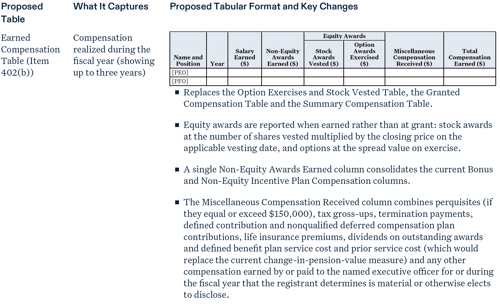
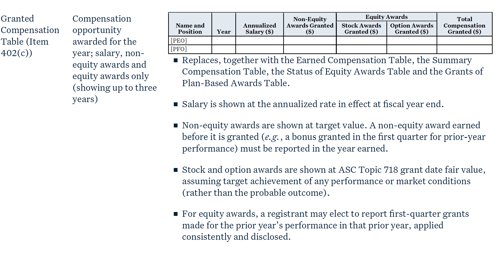
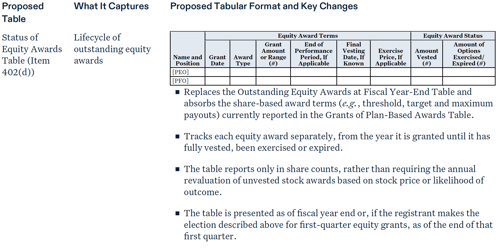
Proposed Item 402(a)(5) would require registrants to disclose information material to an understanding of the three tables—for example, where the target outcome reported in the Granted Compensation Table diverges materially from the probable outcome—and would permit supplemental columns, tables, footnotes and narrative disclosure.
Perquisites: Higher Threshold and Expanded Registrant Discretion
The minimum aggregate reporting threshold for perquisites would rise from $10,000 to $150,000, and registrants could exclude from the calculation any individual item that is a de minimis fringe benefit under Section 132(a)(4) of the Internal Revenue Code. Perquisites would no longer be required to be valued at aggregate incremental cost, and registrants could instead use other methods, such as values determined for tax purposes. The Commission would also revise its 2006 interpretive guidance so that an item is not a perquisite if the registrant reasonably and in good faith determines it is integrally and directly related to the performance of the executive’s duties. The Commission would rescind its prior examples of items requiring disclosure as perquisites—including personal security services and company-required personal use of company aircraft for security purposes—and would allow business purpose to be factored into the analysis. Tax gross-ups, including on perquisites, would continue to be reported separately and would not be subject to the threshold.
Streamlined Compensation Discussion and Analysis
Proposed Item 402(e) would retain CD&A, but reduce it to three required topics: the objectives of the compensation program in relation to corporate strategy; the material elements of compensation and how amounts are determined; and if applicable, whether and how the registrant considered the most recent say-on-pay vote. The current seven enumerated topics and the 15-item illustrative list would be eliminated.
The proposal would also revise the treatment of non-GAAP financial measures used as incentive compensation targets. Registrants could continue to disclose those target levels without complying with Regulation G and Item 10(e) of Regulation S-K, but subject to two new conditions that would apply throughout Item 402, not just in the CD&A. First, where a non-GAAP measure is based on historical financial results, the registrant would be required to show quantitatively how it reconciles to the most directly comparable GAAP measure; where the measure is based on projections, a narrative description of how it is calculated from the registrant’s audited financial statements would suffice. Second, the registrant would need to explain why it believes the non-GAAP measure is more appropriate than a GAAP measure for setting pay. Registrants may still omit target levels whose disclosure would cause competitive harm.
Smaller reporting companies (“SRCs”), emerging growth companies (“EGCs”) and foreign private issuers (“FPIs”) would remain exempt from CD&A.
Termination, Change-in-Control and Golden Parachute Disclosure
Proposed Item 402(i) would replace the current quantified, scenario-by-scenario disclosure of potential payments upon termination or change in control under current Item 402(j) with a qualitative narrative describing the material terms of the PEO and PFO’s arrangements, which SRCs and EGCs would also provide. Proposed Item 402(j) would consolidate and streamline the golden parachute table required in merger proxies under current Item 402(t), reducing the table to four compensation columns (Cash, Equity, Miscellaneous and Total), limiting coverage to the PEO and PFO and replacing mandatory footnotes with a requirement to disclose material information necessary to an understanding of the payments quantified. EGCs would remain exempt from golden parachute disclosure.
CEO Pay Ratio
Proposed Item 402(h) would retain pay ratio disclosure (comparing pay of the PEO to that of the median employee), but narrow the relevant employee population and simplify the calculation. The employee population used to identify the median employee would be limited to full-time employees located in the United States and its territories, excluding part-time, seasonal and temporary workers and all non-U.S. employees. The annual total compensation of the PEO and the median employee would be calculated using the methodology for the Granted Compensation Table. Registrants would be required to re-identify the median employee only once every five years rather than every three years.
Pay-Versus-Performance
Proposed Item 402(f) would retain pay-versus-performance disclosure, as Section 953(a) of the Dodd-Frank Act requires, but eliminate the components the SEC views as most burdensome:
- Executives covered. Disclosure would cover the PEO and PFO only.
- Years covered. Three fiscal years for all registrants, down from five for most registrants.
- Presentation format. The prescribed pay-versus-performance table would be eliminated and replaced with a requirement to clearly describe the relationship between pay and performance in a format of the registrant’s choosing.
- Compensation measure. Total Compensation Earned from the new Earned Compensation Table would replace “compensation actually paid,” eliminating the year-over-year revaluation of unvested and outstanding equity awards.
- Performance measure. The registrant’s cumulative TSR would be the only required measure. Disclosure of GAAP net income, peer group TSR and the tabular list of three to seven financial performance measures would be eliminated, and the company-selected measure would become optional.
- Structured data. Inline XBRL tagging of pay-versus-performance disclosure would be eliminated.
Director Compensation
Proposed Item 402(k) would eliminate the prescribed Director Compensation Table and allow registrants to present director compensation in any format, including narrative and/or tabular form. Registrants would still disclose board, committee and chair retainers separately, aggregate cash earned, the value realized on stock vesting and option exercises (rather than the grant date fair value of awards, so that an annual equity award would generally be reflected in the year it vests rather than the year it is granted) and the material terms and status of outstanding director equity awards. Change in pension value, nonqualified deferred compensation earnings and the exhaustive “all other compensation” list would be replaced by a materiality-based catch-all.
Disclosure Requirements the Commission Would Rescind
- Form 8-K Item 5.02(f), which permits salary or bonus amounts that are not calculable at the time of the proxy filing to be reported later on Form 8-K. The SEC views this accommodation as unnecessary in light of the new 120-day accommodation for long-form registration statements.
- Pension Benefits Table and Nonqualified Deferred Compensation Table (current Items 402(h) and 402(i)), with service cost, prior service cost and plan contributions reported instead in the Earned Compensation Table.
- Item 402(s) compensation risk narrative regarding compensation policies and practices reasonably likely to have a material adverse effect on the registrant.
- Item 402(x) equity grant timing disclosure, including the narrative and table addressing option or SAR grants made close in time to the release of material nonpublic information (so-called spring-loading and bullet-dodging).
Clawback Disclosure
Current Item 402(w) would be redesignated as Item 402(g) and streamlined. Substantive disclosure when recovery is required under Rule 10D-1 would be retained, consistent with Section 954 of the Dodd-Frank Act. However, the proposal would eliminate:
- The requirement to explain why the registrant concluded that recovery was not required following a restatement;
- The requirement to identify, on an individual basis, amounts for which the registrant determined recovery was impracticable; and
- The two check boxes on the cover pages of Forms 10-K, 20-F and 40-F addressing whether the financial statements reflect correction of an error and whether a recovery analysis was required.
Registrants would still disclose the aggregate amount of any recovery forgone as impracticable, with a brief explanation of why recovery was not pursued, and the amounts outstanding for 180 days or more from each current and former NEO. The SEC is not at this time proposing any changes to Rule 10D-1. Inline XBRL tagging of clawback disclosure would be eliminated.
Who Is Covered
Every registrant subject to Item 402 would be affected. Proposed Item 402(a)(6) would consolidate the scaled-disclosure paragraphs into a single provision for each category of filer (assuming the SEC’s separate proposal to change filer categories is not adopted as proposed):
- SRCs would provide two years in the primary tables along with clawback, pay-versus-performance, termination, golden parachute and director compensation disclosure, while remaining exempt from CD&A and pay ratio.
- EGCs would provide two years in the primary tables along with clawback, termination and director compensation disclosure, while remaining exempt from CD&A, pay ratio, pay-versus-performance and golden parachute disclosure.
- FPIs would continue to satisfy Item 402 by providing the disclosure required by Items 6.B, 6.E.2 and 6.F of Form 20-F, plus any more detailed information made public or required by the home jurisdiction or a market on which their securities are listed or traded, or the disclosure required by paragraph 19 of General Instruction B to Form 40-F.
SRCs and EGCs would nonetheless report certain information for the first time, including the value of vested stock and exercised options and pension service cost. If the Commission adopts its separate filer status proposal, the SRC and EGC accommodations would be consolidated into a single non-accelerated filer category and extended to a larger group of registrants (approximately 81% of current registrants, by the SEC’s estimate).
Inline XBRL
Large accelerated filers would be required to tag the Earned Compensation, Granted Compensation and Status of Equity Awards Tables in Inline XBRL. Other filers could elect to tag, but would not be required to do so. Tagging of pay-versus-performance and clawback disclosure would be eliminated. On balance, the proposal would reduce the volume of structured compensation data while concentrating it in the three primary tables.
Registration Statement Timing
Registrants using Forms S-1, S-4, S-11, 10 and N-2 would receive the same accommodation that short-form registrants have today. A long-form registration statement could omit Item 402 disclosure for the most recently completed fiscal year until the earlier of (i) the date the registrant files that information under Section 13(a), 14 or 15(d) of the Exchange Act and (ii) 120 days after fiscal year end (which matches the deadline for filing Item 402 disclosure under the 10-K rules). A registrant seeking effectiveness after that date would supply the disclosure by pre-effective amendment. The pre-effective amendment requirement would apply whether the registration statement goes effective automatically or by acceleration, and registrants omitting the most recent year would still present the number of fiscal years Item 402 requires (three for most registrants, two for SRCs and EGCs), using the years immediately preceding the omitted year. Schedule 14A would not receive a parallel accommodation, although the Commission has requested comment on whether it should.
Effective and Compliance Dates
- Effective date. The next January 1 following publication of an adopting release in the Federal Register. If an adopting release is published during 2027, the effective date would be January 1, 2028.
- Mandatory compliance. The registrant’s first full fiscal year ending on or after the effective date. For registration statements and prospectuses, compliance would be required for any filing that, on its initial filing date, must contain financial statements for a fiscal year ending on or after the effective date.
- Early compliance. Permitted at any time after the effective date, provided the registrant complies with amended Item 402 in its entirety; partial or selective early adoption would not be available.
- Transition period. The Commission has asked whether a phased-in transition is needed for the Earned Compensation and Granted Compensation Tables—for example, reporting only the most recently completed fiscal year in the first filing and building to the full two- or three-year presentation. As proposed, there is no such relief, so prior years would need to be recalculated in the new formats in the first compliant filing.
Practical Considerations
The proposal is a reduction in required disclosure, not a reduction in scrutiny.
- Voluntary disclosure will become a governance decision. Proxy advisors and large institutional investors commonly rely on data the proposal would eliminate or no longer specifically require, such as compensation for executives other than the PEO and PFO, peer group TSR, the tabular list of performance measures, the composition of the compensation peer group and quantified estimates of potential payments upon termination or a change in control. Compensation committees should decide deliberately whether to continue providing that information, and should expect that an abrupt reduction will draw questions. Some companies may elect to continue providing quantified severance and change-in-control estimates, or tabular disclosure for other executive officers, to support shareholder engagement and say-on-pay outcomes. Non-accelerated filers would no longer be required to hold say-on-pay votes if the SEC’s May 19, 2026 filer status proposal (Release No. 33-11419) is adopted as proposed, and those companies should expect shareholders and proxy advisors to express compensation concerns through votes on compensation committee members.
- The shift to realized pay changes the narrative. Reporting vesting and exercise values rather than grant date fair value in the Earned Compensation Table will make reported pay more volatile and more closely tied to stock price performance. Registrants may wish to explain that volatility in the CD&A or through supplemental disclosure.
- Target-based grant values require explanation. Reporting equity awards at the target outcome, where the probable outcome differs materially, would likely trigger the proposed Item 402(a)(5)(i) obligation to disclose information necessary to an understanding of the table. “Moonshot” awards are the clearest case for additional disclosure.
- Pension data becomes an annual input. Service cost and prior service cost would need to be obtained from plan actuaries each year, including by SRCs and EGCs, which do not provide that information today.
- Perquisite policies should be revisited, not relaxed. The higher threshold and good-faith discretion would reduce disclosure, but the determination must be documented and reasonable. Registrants should memorialize the analysis, particularly for executive security and aircraft use, and should continue to review the tax treatment of these benefits.
- Eliminating a required narrative does not eliminate the policy. Rescinding Items 402(s) and 402(x) would remove disclosure obligations, not the underlying insider trading, equity grant timing and compensation risk governance expectations, and material facts about spring-loaded or bullet-dodged grants may still need to be disclosed as necessary to an understanding of the tables. Companies should keep those policies and practices in place.
- Timing relief has a planning cost. The 120-day accommodation for long-form registration statements is valuable for first-quarter IPOs and acquisition registration statements, but requires tracking the trigger date and budgeting for a pre-effective amendment.
* * *
Related Insights


