Highlights
-
“Back-to-Basics” Enforcement Priorities: Under Acting Chairman Caroline D. Pham’s leadership, the CFTC pursued a “back-to-basics” approach to enforcement, prioritizing fraud, manipulation, and direct harm to retail customers. In connection with this shift, the Division of Enforcement consolidated its nine specialized task forces into two task forces and closed approximately half of its open enforcement matters.
-
Ending “Regulation by Enforcement”: CFTC leadership sought to end “regulation by enforcement” and promoted innovation in digital assets and prediction markets. Pham launched a “Crypto Sprint” to implement recommendations from the President’s Working Group on Digital Asset Markets, and the CFTC and SEC announced a cross-agency initiative to harmonize regulatory frameworks for emerging technologies and markets.
-
Revised Enforcement Guidance and Procedures for Regulated Entities: The CFTC issued several new enforcement advisories in 2025, including guidance on the criteria the Division of Enforcement will use to evaluate self-reporting, cooperation, and remediation when recommending an enforcement action to the Commission. A companion advisory clarified that only material compliance violations would be referred to the Division of Enforcement, allowing registrants and registered entities to address certain deficiencies without automatic enforcement referral. The CFTC also reformed the Wells process, extending the response period from 14 to 30 days and requiring written notice of charges when possible.
-
Looking Ahead: Chairman Michael S. Selig is expected to carry forward and accelerate many of these trends. In the first month of his tenure, Selig has taken steps to deepen coordination between the CFTC and the SEC, stated his intent to end “regulation by enforcement,” and announced that he has directed CFTC staff to develop rules to foster innovation in crypto asset and prediction markets.
CFTC Leadership in 2025
On January 20, 2025, following the inauguration of President Donald J. Trump, Commissioner Caroline D. Pham was designated as the CFTC’s Acting Chairman.[1] Pham led the CFTC throughout most of 2025 until her departure on December 22.[2] That same day, Michael S. Selig was sworn in as the 16th Chairman of the CFTC.[3] Selig’s nomination followed President Trump’s withdrawal of his initial nominee, Brian Quintenz.[4]
Prior to his chairmanship, Selig was Chief Counsel of the SEC’s Crypto Task Force and Senior Advisor to SEC Chairman Paul Atkins.[5] He also participated in President Trump’s Working Group on Digital Asset Markets, spent many years in private practice, and was a law clerk for CFTC Commissioner J. Christopher Giancarlo, who served as Chairman of the CFTC during the first Trump administration.[6]
During his confirmation hearing, Selig expressed commitment to “instituting common sense, principles-based regulations that facilitate well-functioning markets and keep pace with the rapid speed of innovation.”[7] He also expressed a desire to “modernize and future-proof” financial regulation to “ensure that the great innovations of tomorrow are made in America.”[8] In January 2026, Selig announced that he had launched a “Future-Proof” initiative and directed CFTC staff to undertake a “comprehensive review of the agency’s existing rules and regulations.”[9] He said the Commission’s aim would be to deliver “clear rules of the road” and “the minimum effective dose of regulation—nothing more and nothing less.”[10]
Chairman Selig is currently the only commissioner at the CFTC. Historically, the CFTC has consisted of five Commissioners serving staggered five-year terms, no more than three of whom may be from the same political party.[11] Over the course of 2025, five Commissioners departed the Commission: Rostin Behnam (February); Summer Mersinger (May); Christy Goldsmith Romero (May); Kristin Johnson (September); and Caroline Pham (December).[12] Although Pham served as the CFTC’s sole commissioner from September to December, the consequences of a single-member Commission will be a source of interest in 2026.
This past year also brought leadership changes within the CFTC’s Division of Enforcement (“DOE” or the “Division”). On January 10, 2025, the CFTC announced that Director of Enforcement Ian McGinley would depart the following week.[13] On February 14, Pham announced that Brian Young, who joined the CFTC in 2024 as Director of the Whistleblower Office, would serve as Director of Enforcement.[14] On June 2, Pham appointed Paul Hayeck Acting Director of the DOE.[15] Hayeck, a long-time CFTC employee, had served as a deputy director in the Division since 2013.[16] Echoing Pham, Hayeck said that he intends to get the DOE “back to basics and focus our resources and abilities on our core mission to prevent fraud, manipulation, and abuse in our markets.”[17]
2025 Enforcement Priorities
Throughout 2025, Pham emphasized that CFTC enforcement must go “back to basics,” refocusing on fraud, manipulation, and abuse.[18] She also “expressed concerns about a ballooning enforcement docket for operational or technical non-compliance issues with no harm.”[19]
In keeping with this prioritization, in March, Pham announced an enforcement sprint to resolve certain compliance-related investigations and enforcement actions—particularly those concerning recordkeeping failures, inadequate supervision, and reporting deficiencies—which she said “divert[] resources away from the most critical aspects of DOE’s mission to protect against fraud, manipulation and abuse in our markets.”[20] In connection with related efforts, she announced that by May 2025, the DOE had “dispositioned 50% (representing several hundreds) of its open enforcement matters, including preliminary investigations, investigations, and litigation.”[21] Pham said resolving these cases enabled “DOE to refocus its resources on catching fraudsters and scammers and helping victims.”[22]
Pham also directed efforts toward ending “regulation by enforcement,” particularly with respect to digital assets and prediction markets.[23] Under her direction, she said the CFTC “refocused on our mandate to promote responsible innovation and fair competition as the CFTC prepares to take on expanded oversight of new markets and new products like digital assets, crypto, and prediction markets.”[24] The past year also brought increased SEC-CFTC collaboration, with the aim of “harmoniz[ing] their approaches” and providing “clear, predictable, and pro-innovation regulatory frameworks,” particularly with respect to these new, growing markets.[25]
The CFTC also implemented several structural changes within the DOE. On February 4, Pham announced that the CFTC was reorganizing the DOE’s nine task forces into two new task forces: the Complex Fraud Task Force and the Retail Fraud and General Enforcement Task Force.[26] She stated that “this simplified structure will stop regulation by enforcement” and “better leverage staff expertise to more efficiently utilize the CFTC’s resources to prevent fraud, manipulation, and abuse and ensure market integrity.”[27]
In May, Pham announced that the Market Surveillance Branch was moved from the DOE back into the Division of Market Oversight (“DMO”).[28] The Market Surveillance Branch had been moved from the DMO to the DOE during the first Trump administration.[29] The CFTC also moved the Whistleblower Office from the DOE to the Office of the General Counsel.[30]
Enforcement Advisories
In 2025, the CFTC and the DOE issued several enforcement advisories and reforms affecting market participants.
Enforcement Advisory on Self-Reporting, Cooperation and Remediation
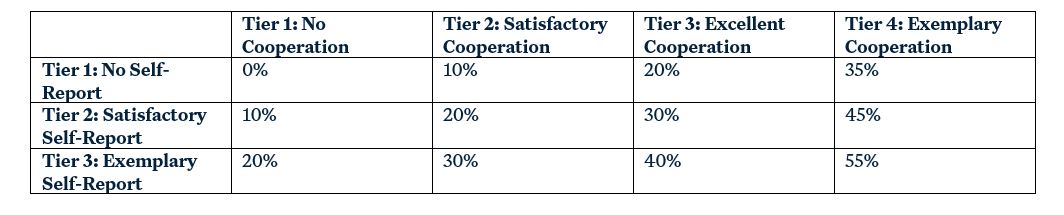
On February 25, 2025, the DOE released an enforcement advisory outlining how the Division will evaluate a company’s or individual’s self-reporting, cooperation, and remediation when recommending enforcement actions to the Commission (“Self-Reporting and Cooperation Advisory”).[31] The Self-Reporting and Cooperation Advisory, which revokes prior guidance previously contained in six different Division advisories and the Division’s Enforcement Manual, provides the first-ever matrix for presumptive discounts, or “mitigation credit,” that a company or individual will receive when it self-reports misconduct and cooperates with the Commission.[32]
The Self-Reporting and Cooperation Advisory establishes a three-tier self-reporting scale: (i) none; (ii) satisfactory; and (iii) exemplary.[33] Key factors for evaluating mitigation credit for a party’s self-report include whether the self-report: (i) was voluntarily made to the Commission before any threat of exposure of the violation; (ii) was disclosed to the DOE or appropriate division of the CFTC; (iii) was disclosed reasonably promptly; and (iv) included “all material information regarding the potential violation known” to the party at the time of the report.[34]
For cooperation, the Self-Reporting and Cooperation Advisory establishes a four-tier scale: (i) none; (ii) satisfactory; (iii) excellent; and (iv) exemplary.[35] The scale considers whether the cooperation resulted in material assistance to an investigation, the adequacy of resources applied to the cooperation, and its extent, timeliness, and voluntariness.[36] At one end of the scale, “no cooperation” applies where a party provided no “substantial assistance beyond required legal obligations.”[37] At the other, “exemplary cooperation” requires, among other things, consistent substantial assistance, internal investigations, accountability measures, and completing remediation.[38] Remediation is evaluated within the cooperation analysis, and focuses on whether a party “engaged in substantial efforts to prevent a future violation.”[39] Notably, even if a party would otherwise merit cooperation credit, any such credit may be offset if it engages in uncooperative conduct such as failing to preserve or produce material information or untimely subpoena compliance.[40]
The Self-Reporting and Cooperation Advisory’s “mitigation credit matrix” provides presumptive credits ranging from 0% to 55% based on these self-reporting and cooperation scales.[41] The DOE retains the discretion to deviate from the matrix given the unique facts and circumstances of a particular case.[42]
 |
In a departure from prior guidance, the Self-Reporting and Cooperation Advisory announced that the DOE will credit self-reports made to the relevant operating divisions (e.g., the DMO) not merely those made directly to the DOE.[43] Mitigation credit is also available for entities that self-report information that they are otherwise required to include in mandatory annual compliance reporting for futures commission merchants, swap dealers, major swap participants, swap execution facilities, and swap data repositories.[44]
The Self-Reporting and Cooperation Advisory includes a safe harbor for any self-report or voluntary disclosure that is later found to be inaccurate if the self-report or voluntary disclosure was made in good faith and promptly supplemented and corrected.[45] It also details that in extraordinary circumstances, such as where a person is the first to self-report a pervasive fraud involving multiple parties and also provides exemplary cooperation, the Division may recommend a declination.[46]
The DOE’s 2025 enforcement actions and resolutions, discussed below, provide insight on DOE’s application of the Self-Reporting and Cooperation Advisory and the mitigation credit matrix.
Staff Advisory on Referrals to DOE
To further the implementation of the Self-Reporting and Cooperation Advisory, on April 17, the Market Participants Division, the Division of Clearing and Risk, the DMO (together, the “Operating Divisions”), and the DOE issued a staff advisory providing guidance on the criteria that the Operating Divisions will use to determine when to refer self-reported violations, supervision issues, and non-compliance issues to the DOE.[47]
Consistent with Pham’s enforcement priorities, under the advisory, when an Operating Division receives a self-report of a supervision or non-compliance issue—such as issues involving a registrant’s supervisory system or controls, compliance program, or risk management system—the Operating Division will assess the materiality of the violation before referring it to the DOE.[48] A DOE referral is warranted only “for a material supervision issue or material non-compliance issue.”[49]
The advisory sets out three criteria for determining whether such an issue is material: (i) “especially egregious or prolonged systematic deficiencies or material weakness of the supervisory system or controls, or program”; (ii) “knowing and willful misconduct by management”; and (iii) a “lack of substantial progress towards completion of a remediation plan for an unreasonably lengthy period of time.”[50] In assessing these criteria, an Operating Division will apply a “reasonableness standard” and consider the “entity’s size, activity, and complexity.”[51]
As set forth in the advisory, the Operating Divisions “will address supervision or non-compliance issues that are not material directly with the registrant or registered entity without referral to DOE.”[52] The advisory further states that entities “should use their own judgment” to determine whether it is appropriate to self-report a material violation—i.e., one involving fraud, manipulation, or abuse—directly to the DOE in the first instance.[53]
Taken together, this advisory and the Self-Reporting and Cooperation Advisory signal a significant shift in the CFTC’s enforcement posture. The CFTC appears to be creating a pathway for registrants to address routine supervisory and compliance deficiencies with the Operating Divisions without the threat of automatic enforcement referral, reserving DOE resources for more serious violations involving fraud, manipulation, or willful misconduct.
Enforcement Advisory on Referrals for Potential Criminal Enforcement
On July 9, the DOE issued an advisory providing guidance in line with Executive Order 14294, “Fighting Overcriminalization in Federal Regulations.”[54] This advisory announced a framework for the DOE to apply when evaluating whether to refer violations of criminal regulatory offenses to the DOJ, including several factors relevant to the evaluation. The factors included the “harm or risk of harm, financial or otherwise, caused by the potential offense”; the defendant’s potential gain; the defendant’s specialized knowledge or expertise; indicia of the defendant’s awareness of the regulation or the unlawfulness of the conduct; whether the defendant is a recidivist; and whether DOJ’s involvement “will provide additional meaningful protection to participants in the derivatives markets.”[55]
The DOE withdrew the advisory on September 5, when the CFTC published a Policy Statement on Referrals for Potential Criminal Enforcement, in accordance with the executive order.[56] The factors set forth in the policy statement are consistent with the staff advisory.[57]
Reforms to the Rules of Practice, Rules Relating to Investigations, and Wells Process
On December 1, the CFTC issued amendments to its Rules of Practice and Rules Relating to Investigations to increase transparency and “enhance due process” in its enforcement actions.[58] With respect to its Rules of Practice, the CFTC required, among other changes, that, when recommending acceptance of a settlement offer, the DOE provide the Commission with an objective memorandum supported by citations to law and evidence that provides a “comprehensive explanation” of the factual and legal basis for the recommendation, distinguishing any “unfavorable facts or legal precedents.”[59]
The CFTC also made several changes to the “Wells process”—the process by which the DOE notifies persons who may be named in an enforcement action of the allegations against them.[60] First, the amendments require DOE staff to provide the Wells notice “in writing when possible” or provide written confirmation after an oral notice.[61] The written notice must identify the charges the DOE intends to recommend to the Commission and may reference specific evidence supporting that recommendation.[62] Second, the CFTC increased the time to respond to a Wells notice (a “Wells submission”) from 14 to 30 days, though the DOE may shorten this period with good cause and director-level approval.[63] Third, a party making a Wells submission may request that the submission be “promptly” provided to the Commission, which may “expedite consideration of the matter.”[64] Finally, all Wells submissions will be forwarded to the Commission, rather than only upon the submitter’s request.[65] Several of these changes mirror those that SEC Chairman Atkins announced regarding the SEC’s Wells process.[66]
2025 Enforcement Actions
The CFTC has not publicly announced annual enforcement results for fiscal year 2025, but enforcement actions published to the CFTC’s website indicate a slowdown from 2024, when the CFTC brought 58 new enforcement actions and secured a record-setting $17.1 billion in monetary relief.[67]
Fraud Enforcement
Consistent with the priorities discussed above, most of the DOE’s 2025 enforcement resolutions involved allegations of fraud.
In 2025, the DOE’s largest recoveries occurred in matters in which the CFTC pursued foreign defendants involved in schemes targeting U.S. citizens. For example, the CFTC secured a default judgment against five foreign entities and three foreign citizens involved in a binary options fraud scheme in which defendants allegedly made numerous misrepresentations to solicit customers to trade “illegal, off-exchange binary options,” manipulated the trading platform’s settings to interfere with customers’ trades, and used various deceptive means to prevent customers from withdrawing their funds.[68] The judgment ordered defendants to pay a $338.7 million civil monetary penalty and $112.9 million in restitution. [69] The CFTC’s complaint in this action was originally filed in 2019.[70] Two of the individual defendants were previously sentenced to 20 and 5.5 years in prison, respectively, for substantially the same conduct as alleged in the CFTC complaint.[71]
The CFTC also obtained a default judgment against two foreign nationals who falsely claimed to maintain an automated trading program and misled customers regarding the use of participant funds and participant returns.[72] The CFTC’s complaint in this action was originally filed in 2022. The default judgment ordered a $96.5 million civil monetary penalty and more than $32 million in disgorgement.[73] Defendants’ Florida-based head trader was also ordered to pay $289,000 in disgorgement and $867,000 in civil monetary penalties.[74] The DOJ and SEC had previously resolved parallel criminal and civil enforcement actions against the defendants.[75]
Several 2025 resolutions involved Ponzi-like schemes. For example, the CFTC pursued claims, originally filed in 2024, against two individuals and their firm, Agridime LLC, alleging the defendants solicited customer funds ostensibly to buy, raise, and process cattle into beef, but instead used those funds to pay earlier customers and pay themselves commissions.[76] Pursuant to a consent order, Agridime was required to pay $102.9 million in restitution and was banned from registering with the CFTC or trading in any CFTC-regulated markets.[77] The CFTC obtained a default judgment ordering the individual defendants to pay $815,327 and $1,472,127 in disgorgement, respectively, and imposing trading and registration bans.[78]
Several actions reflected a particular concern for frauds targeting vulnerable populations. For example, the CFTC obtained a final judgment in a 2022 action—which it brought alongside 30 state regulators and the SEC—against Safeguard Metals LLC and Jeffrey Ikahn for a scheme in which the defendants made false claims to senior citizens about the risk of traditional retirement accounts, sold them precious metals at inflated prices, and misrepresented the basis for the overcharge.[79] The defendants were ordered to pay a $25,569,303 civil monetary penalty and the same amount in restitution.[80] In another action, the CFTC filed charges against DSD Capital Management, LLC and its founder for allegedly defrauding an individual and his elderly mother and misappropriating their retirement funds.[81] The U.S. Attorney’s Office for the Northern District of New York also charged the founder with wire fraud and aggravated identity theft.[82]
Digital Assets Enforcement
In 2025, the CFTC aligned its digital assets enforcement priorities with the Trump administration’s goal of “support[ing] the responsible growth and use of digital assets, blockchain technology, and related technologies.”[83] Pham criticized “regulation-by-enforcement” as having “held back U.S. businesses and entrepreneurs whilst the rest of the world established frameworks for digital assets and crypto.”[84]
Beginning in January, Pham launched a series of roundtables on evolving trends and innovation in market structure, including one on trends in digital assets, and hosted the CFTC’s first Crypto CEO forum.[85]
In April, she directed CFTC staff and the Director of Enforcement to adhere to DOJ policy[86] on digital assets enforcement.[87] Specifically, she directed CFTC staff and the Director of Enforcement not to charge regulatory violations in cases involving digital assets unless “there is evidence that the defendant knew of the licensing or registration requirement at issue and violated such a requirement willfully.”[88] She also directed them not to take any litigation position inconsistent with executive orders, Trump administration policy, or DOJ policy on digital assets enforcement priorities.[89]
In August, the CFTC launched a “Crypto Sprint” to implement recommendations from the President’s Working Group on Digital Asset Markets.[90] Shortly thereafter, the CFTC and SEC issued a joint staff statement announcing a cross-agency initiative to promote “regulatory clarity that best keeps blockchain-based innovation within the United States” and stating their view “that [CFTC- and SEC-registered entities] are not prohibited from facilitating the trading of certain spot crypto asset products.”[91] SEC Chairman Paul Atkins and Pham declared it “a new day” for their agencies and committed to harmonizing regulatory frameworks to “foster innovation, and solidify the United States as the global leader in crypto and blockchain technology.”[92] Pham characterized the effort as “a new beginning for coordination” and an end to “the turf war” between the agencies.[93]
Consistent with these objectives and approach, digital-asset enforcement in 2025 focused on fraud schemes that caused direct harm to retail customers. These actions generally involved misappropriation of customer funds through deceptive practices such as operating fake trading platforms,[94] selling non-functional virtual currencies,[95] misrepresenting profit margins,[96] or making false statements regarding fund structure, performance, trading activity, and customers’ ability to withdraw funds.[97] All of these actions were initiated by the CFTC prior to 2025 and several involved parallel criminal proceedings.
In a notable exception to this trend, shortly before President Trump’s inauguration, the CFTC resolved an action against Gemini Trust Company, LLC for allegedly making false or misleading statements to the Commission during the self-certification process for a bitcoin futures contract.[98] Gemini consented to the entry of an order imposing a $5 million civil monetary penalty without admitting or denying the substantive allegations.[99]
Chairman Selig appears poised to take a similar approach to digital assets in 2026.[100] On January 29, 2026, in his first public remarks as Chairman, Selig announced that the CFTC would be partnering with the SEC on Project Crypto rather than running the Crypto Sprint in parallel.[101] Selig described this partnership as a “generational opportunity” intended to bring “coordination, coherence, and a unified approach to the federal oversight of crypto asset markets.”[102] Selig and SEC Chairman Atkins said their CFTC-SEC harmonization agenda would begin with “aligned definitions, coordinated oversight, and seamless, secure data sharing” and would reflect a shared philosophy that “financial regulation must be precise, not punitive.”[103]
Selig’s remarks also endorsed Atkins’s position that “most crypto assets trading today are not securities” and announced initiatives to facilitate innovation in crypto asset markets, including directing staff to: (i) develop rules for additional forms of tokenized collateral; (ii) create frameworks for perpetual derivative products in the U.S.; (iii) explore safe harbors for software developers and a potential “innovation exemption”; and (iv) clarify when leveraged retail crypto transactions may proceed off-exchange under an “actual delivery” exception and explore a new DCM registration category for retail leveraged crypto trading.[104]
Prediction Markets
As with digital assets, Pham sought to promote innovation in prediction markets (i.e., event contracts), identifying “CFTC examinations, enforcement actions, and investigations” as some of the “key obstacles to balanced regulation of prediction markets.”[105] To discuss those obstacles, she hosted a prediction markets roundtable with the goal of establishing “a holistic regulatory framework that will both foster thriving prediction markets and protect retail customers from binary options fraud such as deceptive and abusive marketing and sales practices.”[106]
In 2025, CFTC staff issued several no-action letters to prediction markets platforms—including Kalshi, PredictIt, Polymarket, and Gemini Titan—stating that the DMO and the Division of Clearing and Risk would not recommend that the Commission initiate enforcement actions for failure to comply with certain swap-related recordkeeping and swap data reporting requirements for certain event contracts “executed on or subject to the rules of the registered entities.”[107] No-action letters do not change the law and are not a new tool—Kalshi first obtained a no-action letter from the CFTC in April 2021.[108]
In May 2025, the CFTC also voluntarily withdrew its appeal of a 2024 opinion holding that the CFTC had exceeded its statutory authority when it issued an order prohibiting Kalshi from offering event contracts that allowed individuals to predict the outcomes of U.S. elections.[109] The CFTC had previously argued that it could prohibit political contracts on the basis that they fall within the Commodity Exchange Act’s definition of “gaming,” involve activity that is unlawful under state law, and are contrary to the public interest.[110] The CFTC’s withdrawal of the appeal marked a notable change in its approach to these markets.
We anticipate that 2026 will be a key year for regulatory developments with respect to prediction markets. In his first public remarks, Chairman Selig said “it is time for clear rules and a clear understanding that the CFTC supports lawful innovation in these markets.”[111] He announced that he had directed CFTC staff to: (i) withdraw a 2024 rule proposal defining political and sports-related event contracts as contrary to the public interest and a 2025 staff advisory cautioning against sports contracts; (ii) move forward with new rulemaking for prediction markets; (iii) “reassess the Commission’s participation in matters currently pending before the federal district and circuit courts” concerning event contracts, noting the CFTC’s “responsibility to defend its exclusive jurisdiction over commodity derivatives”; and (iv) work with the SEC to develop clearer lines between certain commodity and security options, CFTC-regulated swaps, and SEC-regulated swaps.[112]
Compliance-Related Violations
Consistent with its back-to-basics approach to enforcement and Pham’s criticisms of “enforcement penalties that have become a tax on doing business,” the CFTC adopted a more limited approach to enforcing compliance violations.[113]
In March, the DOE conducted an “enforcement sprint” to resolve open compliance violations.[114] The sprint resulted in six compliance-related orders against 10 major financial institutions.[115] These actions addressed three categories of conduct: (i) systems errors that led to violations of reporting, recordkeeping, and supervision requirements; (ii) employees using improper means of communication (e.g., text messages, WhatsApp) to discuss firm business, resulting in violations of recordkeeping and supervision requirements; and (iii) swap data reporting violations.[116]
Each institution submitted remediation plans and settlement offers and received mitigation credit pursuant to the Self-Reporting and Cooperation Advisory.[117] Pursuant to the advisory, two institutions received reduced monetary penalties reflecting maximum mitigation credit for both exemplary self-reporting and exemplary cooperation; five received reduced monetary penalties reflecting maximum cooperation credit but no credit for self-reporting; and three received no credit for either self-reporting or cooperation.[118]
We anticipate that market participants will see this trend continue in 2026. During his confirmation hearing, Chairman Selig expressed concerns about “red tape,” recalling an experience in which he helped a firm “that was forced to divert significant time and resources from its business to defend itself in an extensive investigation for harmless errors in its swap data reporting.”[119]
Disruptive Conduct and Trade Practice Violations
Although it prioritized fraud, the CFTC also resolved actions involving spoofing and wash trading. Penalties in these actions were considerably smaller than in fraud cases. The CFTC simultaneously filed and settled charges against Flatiron Futures Traders LLC and trader Brett Falloon for allegedly spoofing in E-mini S&P 500 and E-mini Nasdaq 100 futures on the Chicago Mercantile Exchange.[120] Flatiron and Falloon neither admitted nor denied the findings, but agreed to pay, jointly and severally, a $200,000 civil monetary penalty. Falloon also received a 12-month trading ban.[121] The Commission also simultaneously filed and settled charges against Shinhan Securities Co. Ltd. for allegedly executing 127 wash trades on NYMEX with an approximate aggregate value of $33.5 million.[122] Without admitting or denying the Commission’s findings, Shinhan consented to the entry of an order imposing a $212,500 civil monetary penalty, which reflected a 20% reduction for Shinhan’s “excellent cooperation” with the DOE.[123]
Whistleblower Awards
The CFTC continued to promote the whistleblower program in 2025, issuing awards to three individuals. One whistleblower received approximately $700,000 for providing “highly significant” information and a “high degree of assistance” leading to monetary sanctions.[124] The award was reduced, however, because the Commission concluded that the whistleblower unreasonably delayed reporting and was personally culpable in the violations.[125] Two other whistleblowers received more than $1.8 million for providing “crucial evidence” that significantly contributed to a successful enforcement.[126]
Looking Ahead
Looking ahead, we anticipate Chairman Selig will carry forward and accelerate many of the trends seen in 2025. In the first month of his tenure, he has launched several significant reforms and announced that the CFTC will “sharpen[] its focus on regulatory clarity, inter-agency coordination, and permissionless innovation.”[127] Notably, the CFTC is now partnering with the SEC on Project Crypto, which aims to “advance a clear crypto asset taxonomy, clarify jurisdictional lines, remove duplicative compliance requirements, and reduce regulatory fragmentation.”[128] Selig has also directed staff to develop rules expanding eligible tokenized collateral, create pathways to onshore perpetual derivatives, establish “clear and unambiguous safe harbors for software developers,” and draft new rulemaking to provide greater clarity and certainty for prediction markets.[129]
As the CFTC embarks on this new chapter, Selig has cautioned that it will “not abandon [its] age-old principles, like investor protection, anti-fraud and anti-manipulation, and market integrity, which remain [its] north star.”[130] In the year ahead, we anticipate that the DOE will continue to prioritize enforcement actions targeting fraud and manipulation that harm retail customers. At the same time, registrants will likely continue to have greater latitude to address supervisory and compliance deficiencies directly with the relevant Operating Divisions. Robust internal compliance systems will therefore be critical, both to avoid material issues that could trigger escalation to the DOE and to identify potential violations early, enabling market participants to capitalize on the benefits of self-reporting, cooperation, and remediation outlined in the DOE’s Self-Reporting and Cooperation Advisory.
Market participants should continue to monitor these developments closely.
* * *
[1] CFTC Press Release, CFTC Names Caroline D. Pham Acting Chairman (Jan. 20, 2025), https://www.cftc.gov/PressRoom/PressReleases/9035-25.
[2] CFTC Press Release, Acting Chairman Caroline D. Pham Announces Departure from CFTC (Dec. 22, 2025), https://www.cftc.gov/PressRoom/PressReleases/9163-25.
[3] CFTC Press Release, Michael Selig Sworn In as 16th CFTC Chairman (Dec. 22, 2025), https://www.cftc.gov/PressRoom/PressReleases/9164-25.
[4] Meredith Lee Hill and Declan Harty, White House pulls Brian Quintenz nomination to lead CFTC, Politico (Sept. 30, 2025), https://www.politico.com/live-updates/2025/09/30/congress/white-house-pulls-quintenz-nomination-to-lead-cftc-00589043.
[5] Hearing on the Nomination of Michael Selig to be Chairman of the Commodity Futures Trading Commission Before the S. Comm. on Agriculture, Nutrition, and Forestry, 119th Cong. 2 (Opening Statement of Michael S. Selig, Nov. 19, 2025), https://www.agriculture.senate.gov/imo/media/doc/52c5cea6-9d90-5a72-c9c7-9bdd6e46fd11/Testimony_Selig_11.19.2025.pdf.
[6] Id.
[7] Id.
[8] Id.
[9] Michael S. Selig, America’s financial markets are ready for a golden age, Wash. Post (Jan. 20, 2026), https://www.washingtonpost.com/opinions/2026/01/20/cftc-trump-administration-markets-regulation/.
[10] Id.
[11] Chairman & Commissioners, CFTC, https://www.cftc.gov/About/Commissioners/index.htm.
[12] CFTC Press Release, Chairman Rostin Behnam Announces Departure from CFTC (Jan. 7, 2025), https://www.cftc.gov/PressRoom/SpeechesTestimony/behnamstatement010725; CFTC Press Release, Statement by Commissioner Summer K. Mersinger on her Departure from the Commodity Futures Trading Commission (May 14, 2025), https://www.cftc.gov/PressRoom/SpeechesTestimony/mersingerstatement051425; CFTC Press Release, Commissioner Christy Goldsmith Romero Announces Departure from CFTC (May 16, 2025), https://www.cftc.gov/PressRoom/SpeechesTestimony/romerostatement051625; CFTC Press Release, Commissioner Kristin Johnson Announces Departure from CFTC (Aug. 26, 2025), https://www.cftc.gov/PressRoom/SpeechesTestimony/opajohnson24; CFTC Press Release, Acting Chairman Caroline D. Pham Announces Departure from CFTC (Dec. 22, 2025), https://www.cftc.gov/PressRoom/PressReleases/9163-25.
[13] CFTC Press Release, CFTC Announces Departure of Enforcement Director Ian McGinley (Jan. 10, 2025), https://www.cftc.gov/PressRoom/PressReleases/9029-25.
[14] CFTC Press Release, Acting Chairman Pham Announces Brian Young as Director of Enforcement (Feb. 14, 2025), https://www.cftc.gov/PressRoom/PressReleases/9053-25.
[15] CFTC Press Release, CFTC Names Paul Hayeck as Acting Director of Division of Enforcement (June 2, 2025), https://www.cftc.gov/PressRoom/PressReleases/9082-25.
[16] Id.
[17] Id.
[18] Caroline D. Pham, CFTC, Keynote Address at FIA BOCA50 (Mar. 11, 2025), https://www.cftc.gov/PressRoom/SpeechesTestimony/opapham13.
[19] CFTC Press Release, Acting Chairman Pham Announces Successful Completion of Enforcement Sprint (Sept. 4, 2025), https://www.cftc.gov/PressRoom/PressReleases/9114-25.
[20] Id.
[21] Caroline D. Pham, CFTC, 100 Days: Keynote Address at the 39th ISDA Annual General Meeting (May 15, 2025), https://www.cftc.gov/PressRoom/SpeechesTestimony/opapham15); Caroline D. Pham, CFTC, Keynote Address at FIA BOCA50 (Mar. 11, 2025), https://www.cftc.gov/PressRoom/SpeechesTestimony/opapham13.
[22] Id.
[23] CFTC Press Release, CFTC Division of Enforcement to Refocus on Fraud and Helping Victims, Stop Regulation by Enforcement (Feb. 4, 2025), https://www.cftc.gov/PressRoom/PressReleases/9044-25.
[24] CFTC Press Release, Chairman Caroline D. Pham Announces Departure from CFTC (Dec. 22, 2025), https://www.cftc.gov/PressRoom/PressReleases/9163-25.
[25] CFTC Press Release, Joint Statement from the Chairman of the SEC and Acting Chairman of the CFTC (Sept. 5, 2025), https://www.cftc.gov/PressRoom/SpeechesTestimony/phamatkinsstatement090525.
[26] CFTC Press Release, CFTC Division of Enforcement to Refocus on Fraud and Helping Victims, Stop Regulation by Enforcement (Feb. 4, 2025), https://www.cftc.gov/PressRoom/PressReleases/9044-25.
[27] Id.
[28] Caroline D. Pham, CFTC, 100 Days: Keynote Address at the 39th ISDA Annual General Meeting (May 15, 2025), https://www.cftc.gov/PressRoom/SpeechesTestimony/opapham15.
[29] Remarks of Acting Chairman J. Christopher Giancarlo before the 42nd Annual International Futures Industry Conference in Boca Raton, FL (Mar. 15, 2017), https://www.cftc.gov/PressRoom/SpeechesTestimony/opagiancarlo-20.
[30] Caroline D. Pham, CFTC, 100 Days: Keynote Address at the 39th ISDA Annual General Meeting (May 15, 2025), https://www.cftc.gov/PressRoom/SpeechesTestimony/opapham15.
[31] CFTC Press Release, CFTC Releases Enforcement Advisory on Self-Reporting, Cooperation, and Remediation (Feb. 25, 2025), https://www.cftc.gov/PressRoom/PressReleases/9054-25.
[32] CFTC Enforcement Advisory, Advisory on Self-Reporting, Cooperation, and Remediation (Feb. 25, 2025), https://www.cftc.gov/media/11821/EnfAdv_Resolutions022525/download ; see also Caroline D. Pham, CFTC, Keynote Address at FIA BOCA50 (Mar. 11, 2025), https://www.cftc.gov/PressRoom/SpeechesTestimony/opapham13.
[33] CFTC Enforcement Advisory, Advisory on Self-Reporting, Cooperation, and Remediation at 5 (Feb. 25, 2025), https://www.cftc.gov/media/11821/EnfAdv_Resolutions022525/download.
[34] Id. at 3–7.
[35] Id. at 7.
[36] Id. at 7–9.
[37] Id. at 12.
[38] Id. at 8, 12.
[39] Id. at 9–10.
[40] Id.at 11.
[41] Id. at 12–13.
[42] Id. at 13–14.
[43] Id. at 2.
[44] Id.
[45] Id. at 5.
[46] Id. at 14.
[47] Staff Advisory On Materiality Or Other Criteria That Operating Divisions Will Use To Determine Referrals To the Division of Enforcement, CFTCLTR No. 25-13, 2025 WL 1166372 (Apr. 17, 2025).
[48] Id., at *2.
[49] Id.
[50] Id.
[51] Id.
[52] Id.
[53] Id., at *1.
[54] CFTC Press Release, CFTC Issues Advisory on Referrals for Potential Criminal Enforcement (July 9, 2025), https://www.cftc.gov/PressRoom/PressReleases/9094-25.
[55] Id.
[56] CFTC Press Release, CFTC Issues Policy Statement on Referrals for Potential Criminal Enforcement (Sept. 5, 2025), https://www.cftc.gov/PressRoom/PressReleases/9116-25.
[57] Policy Statement Concerning Agency Referrals for Potential Criminal Enforcement, 90 Fed. Reg. 43586 (Sept. 10, 2025), https://www.federalregister.gov/documents/2025/09/10/2025-17400/policy-statement-concerning-agency-referrals-for-potential-criminal-enforcement.
[58] CFTC Press Release, Acting Chairman Pham Announces Reforms to Wells Process, Amends Rules of Practice and Rules Relating to Investigations (Dec. 1, 2025), https://www.cftc.gov/PressRoom/PressReleases/9144-25.
[59] Amendments to CFTC Rules of Practice and Rules Relating to Investigations, 90 Fed. Reg. 55642, 55643 (Dec. 3, 2025).
[60] Id.
[61] Id.
[62] Id.
[63] Id.
[64] Id.
[65] Id.
[66] See Paul, Weiss Publications, SEC Enforcement: 2025 Year in Review (Jan. 5, 2026), https://www.paulweiss.com/insights/client-memos/sec-enforcement-2025-year-in-review.
[67] CFTC Press Release, CFTC Releases FY 2024 Enforcement Results, Sanctions (Dec. 4, 2024), https://www.cftc.gov/PressRoom/PressReleases/9011-24
[68] Default Judgment Order, CFTC v. Yukom Communications Ltd., No. 1:19-CV-05416 (N.D. Ill. Jan. 29, 2025), Dkt. No. 108; CFTC Press Release, Federal Court Orders International Enterprise to Pay Over $451 Million for Global Binary Options Fraud (Jan. 29, 2025), https://www.cftc.gov/PressRoom/PressReleases/9040-25; see also CFTC Press Release, Federal Court Orders Israeli Man to Disgorge $7 Million in Gains from Fraudulent Binary Options Scheme (Sept. 9, 2024), https://www.cftc.gov/PressRoom/PressReleases/8962-24.
[69] Default Judgment Order, CFTC v. Yukom Communications Ltd., No. 1:19-CV-05416 (N.D. Ill. Jan. 29, 2025), Dkt. No. 108.
[70] Id.
[71] CFTC Press Release, Federal Court Orders International Enterprise to Pay Over $451 Million for Global Binary Options Fraud (Jan. 29, 2025), https://www.cftc.gov/PressRoom/PressReleases/9040-25.
[72] CFTC Press Release, Florida Court Orders Brazilian Nationals to Pay Over $128 Million for Fraudulent Commodity Pool Scheme (Feb. 4, 2025), https://www.cftc.gov/PressRoom/PressReleases/9045-25; CFTC Press Release, Federal Court Orders Unregistered Florida Commodity Pool Operator to Pay Over $64 Million in Monetary Sanctions for Fraudulent Scheme (Mar. 15, 2024), https://www.cftc.gov/PressRoom/PressReleases/8879-24; Final Default Judgment Order, CFTC v. Pires, No. 22-CV-21997 (S.D. Fla. Feb. 4, 2025), Dkt. No. 53.
[73] Final Default Judgment Order, CFTC v. Pires, No. 22-CV-21997 (S.D. Fla. Feb. 4, 2025), Dkt. No. 53.
[74] Id.
[75] CFTC Press Release, Florida Court Orders Brazilian Nationals to Pay Over $128 Million for Fraudulent Commodity Pool Scheme (Feb. 4, 2025), https://www.cftc.gov/PressRoom/PressReleases/9045-25.
[76] CFTC Press Release, Federal Court Orders Texas Firm to Pay Over $100 Million to Customers Defrauded in Cattle Fraud Scheme (June 16, 2025), https://www.cftc.gov/PressRoom/PressReleases/9087-25.
[77] Consent Order, CFTC v. Agridime LLC, No. 4:24-cv-0424 (N.D. Tex. June 10, 2025), Dkt. No. 44.
[78] Default Judgment Order, CFTC v. Agridime LLC, No. 4:24-cv-0424 (N.D. Tex. June 2, 2025), Dkt. No. 43.
[79] CFTC Press Release, CFTC, 30 State Regulators Obtain Over $51 Million in Sanctions, Restitution for Victims in California Precious Metals Fraud (Nov. 20, 2025), https://www.cftc.gov/PressRoom/PressReleases/9139-25; Final Judgment, CFTC v. Safeguard Metals LLC, No. 22-cv-00691 (C.D. Cal. Sept. 30, 2025), Dkt. No. 240; Consent Order, CFTC v. Safeguard Metals LLC, No. 22-cv-00691 (C.D. Cal. Oct. 20, 2023), Dkt. No. 201.
[80] Final Judgment, CFTC v. Safeguard Metals LLC, No. 22-cv-00691 (C.D. Cal. Sept. 30, 2025), Dkt. No. 240.
[81] CFTC Press Release, CFTC Charges Syracuse, N.Y., Man, His Firm with Fraud, Misappropriation (May 8, 2025), https://www.cftc.gov/PressRoom/PressReleases/9072-25.
[82] Id.
[83] Exec. Order 14,178, 90 Fed. Reg. 8647 (Jan. 31, 2025).
[84] Caroline D. Pham, CFTC, Keynote Address at the FIA EXPO (Nov. 18, 2025), https://www.cftc.gov/PressRoom/SpeechesTestimony/opapham19).
[85] CFTC Press Release, Acting Chairman Pham to Launch Public Roundtables on Innovation and Market Structure (Jan. 27 2025), https://www.cftc.gov/PressRoom/PressReleases/9038-25; CFTC Press Release, CFTC Announces Crypto CEO Forum to Launch Digital Asset Markets Pilot (Feb. 7, 2025), https://www.cftc.gov/PressRoom/PressReleases/9049-25.
[86] Memorandum from Dep. Atty Gen. Todd Blanche to all Dep’t Emps. re: Ending Regulation By Prosecution (Apr. 7, 2025), https://www.justice.gov/dag/media/1395781/dl?inline.
[87] CFTC Press Release, Acting Chairman Pham Lauds DOJ Policy Ending Regulation by Prosecution of Digital Assets Industry and Directs CFTC Staff to Comply with Executive Orders (Apr. 8, 2025), https://www.cftc.gov/PressRoom/PressReleases/9063-25.
[88] Id.
[89] Id.
[90] CFTC Press Release, Acting Chairman Pham Announces CFTC Crypto Sprint (Aug. 1, 2025), https://www.cftc.gov/PressRoom/PressReleases/9104-25
[91] CFTC Press Release, CFTC-SEC Joint Staff Statement (Project Crypto-Crypto Sprint) (Sept. 2, 2025), https://www.cftc.gov/PressRoom/SpeechesTestimony/cftcsecjointcryptostatement090225.
[92] Paul Atkins & Caroline D. Pham, Joint Statement from the Chairman of the SEC and Acting Chairman of the CFTC (Sept. 5, 2025), https://www.cftc.gov/PressRoom/SpeechesTestimony/phamatkinsstatement090525.
[93] Caroline D. Pham, CFTC, Keynote Address at the FIA EXPO(Nov. 18, 2025), https://www.cftc.gov/PressRoom/SpeechesTestimony/opapham19.
[94] CFTC Press Release, Federal Court Orders Recovery of Nearly $2.3M for Victims of an Online Romance Scam (Mar. 21, 2025), https://www.cftc.gov/PressRoom/PressReleases/9058-25; Order Entering Default, CFTC v. Debiex, No. 24-CV-00117 (D. Ariz. Mar. 12, 2025), Dkt. No. 29.
[95] CFTC Press Release, Federal Court Orders Florida Man to Pay Over $7.6 Million for Digital Asset Fraud (Feb. 10, 2025), https://www.cftc.gov/PressRoom/PressReleases/9051-25; CFTC Press Release, Federal Court Orders Michigan Man, California Man, and Two Nevada Companies to Pay Over $25 Million for Digital Asset Fraud (June 11, 2025), https://www.cftc.gov/PressRoom/PressReleases/9084-25; Default Judgment, CFTC v. My Big Coin Pay, Inc., No. 18-cv-10077 (D. Mass. June 5, 2025), Dkt. No. 198; Consent Order, CFTC v. My Big Coin Pay, Inc., No. 18-cv-10077 (D. Mass. Feb. 6, 2025), Dkt. No. 182.
[96] CFTC Press Release, Mosaic Exchange Ltd. and CEO Ordered to Pay Over $1.1 Million for Fraudulent Digital Asset Commodity Scheme (Jan. 13, 2025), https://www.cftc.gov/PressRoom/PressReleases/9032-25.
[97] Consent Order, CFTC v. Rashawn Russell , No. 23-CV-02691 (E.D.N.Y. Jan. 16, 2025), Dkt. No. 21; CFTC Press Release, Federal Court Orders New York Resident to Pay Over $1.5 Million in Digital Assets Trading Scheme (Feb. 10, 2025), https://www.cftc.gov/PressRoom/PressReleases/9050-25.
[98] CFTC Press Release, Gemini Trust Ordered to pay $5 Million for Making False or Misleading Statements, Omissions to the CFTC (Jan. 13, 2025), https://www.cftc.gov/PressRoom/PressReleases/9031-25.
[99] Id.
[100] Paul, Weiss Publications, CFTC Chairman Outlines Regulatory Agenda for Prediction Markets and Cryptocurrency and SDNY Signals Focus on Prediction Markets Fraud (Feb. 12, 2026), https://www.paulweiss.com/insights/client-memos/cftc-chairman-outlines-regulatory-agenda-for-prediction-markets-and-cryptocurrency-and-sdny-signals-focus-on-prediction-markets-fraud.
[101] Michael S. Selig, Remarks of Chairman Michael S. Selig at CFTC-SEC Event on Harmonization—The Next Phase of Project Crypto: Unleashing Innovation for the New Frontier of Finance (Jan. 29, 2026), https://www.cftc.gov/PressRoom/SpeechesTestimony/opaselig1.
[102] Id.
[103] CFTC Press Release, CFTC Chair Selig, SEC Chair Atkins: Team Trump readies crypto plan so Americans can count on their future (Jan. 29, 2026), https://www.cftc.gov/PressRoom/SpeechesTestimony/seligstatement012926a.
[104] Michael S. Selig, Remarks of Chairman Michael S. Selig at CFTC-SEC Event on Harmonization—The Next Phase of Project Crypto: Unleashing Innovation for the New Frontier of Finance (Jan. 29, 2026), https://www.cftc.gov/PressRoom/SpeechesTestimony/opaselig1.
[105] CFTC Press Release, CFTC Announces Prediction Markets Roundtable (Feb. 5, 2025), https://www.cftc.gov/PressRoom/PressReleases/9046-25.
[106] Id.
[107] CFTC Press Release, CFTC Staff Issues No-Action Letters Regarding Event Contracts (Dec. 11, 2025), https://www.cftc.gov/PressRoom/PressReleases/9154-25; see also CFTC Press Release, CFTC Staff Issues Supplemental Letter Regarding No-Action Position on Reporting, Recordkeeping Requirements (Jan. 31, 2025), https://www.cftc.gov/PressRoom/PressReleases/9042-25; CFTC Press Release, CFTC Staff Issues No-Action Letter Regarding Event Contracts (Sept. 3, 2025), https://www.cftc.gov/PressRoom/PressReleases/9113-25.
[108] CFTC Letter No. 21-11 (Apr. 22, 2021), https://www.cftc.gov/csl/21-11/download.
[109] KalshiEX LLC v. Commodity Futures Trading Comm’n, No. 24-5205, 2025 WL 1349979, at *1 (D.C. Cir. May 7, 2025).
[110] KalshiEX LLC v. Commodity Futures Trading Comm’n, No. CV 23-3257 (JMC), 2024 WL 4164694, at *1 (D.D.C. Sept. 12, 2024), dismissed, No. 24-5205, 2025 WL 1349979 (D.C. Cir. May 7, 2025).
[111] Michael S. Selig, Remarks of Chairman Michael S. Selig at CFTC-SEC Event on Harmonization—The Next Phase of Project Crypto: Unleashing Innovation for the New Frontier of Finance (Jan. 29, 2026), https://www.cftc.gov/PressRoom/SpeechesTestimony/opaselig1.
[112] Id.
[113] Caroline D. Pham, CFTC, Remarks by Acting Chairman Caroline D. Pham, 100 Impact Leaders Dinner and Annual Awards, Digital Assets Global Forum, UK House of Lords (June 23, 2025), https://www.cftc.gov/PressRoom/SpeechesTestimony/opapham17.
[114] Caroline D. Pham, CFTC, Keynote Address at FIA BOCA50 (Mar. 11, 2025), https://www.cftc.gov/PressRoom/SpeechesTestimony/opapham13.
[115] CFTC Press Release, Acting Chairman Pham Announces Successful Completion of Enforcement Sprint (Sept. 4, 2025), https://www.cftc.gov/PressRoom/PressReleases/9114-25.
[116] Id.
[117] Id.
[118] Id.
[119] Hearing on the Nomination of Michael Selig to be Chairman of the Commodity Futures Trading Commission Before the S. Comm. on Agriculture, Nutrition, and Forestry, 119th Cong. 2 (statement of Michael S. Selig), https://www.agriculture.senate.gov/imo/media/doc/52c5cea6-9d90-5a72-c9c7-9bdd6e46fd11/Testimony_Selig_11.19.2025.pdf.
[120] CFTC Press Release, CFTC Sanctions Colorado Trader and Illinois Company to Pay $200,000 for Spoofing (Sept. 9, 2025), https://www.cftc.gov/PressRoom/PressReleases/9118-25.
[121] Id.
[122] CFTC Press Release, CFTC Sanctions Trading Firm $212,500 for Wash Sales (Sept. 17, 2025), https://www.cftc.gov/PressRoom/PressReleases/9125-25; In re Shinhan Securities Co. Ltd., CFTC No. 25-08 (Sept. 17, 2025).
[123] In re Shinhan Securities Co. Ltd., CFTC No. 25-08 (Sept. 17, 2025).
[124] CFTC Press Release, CFTC Awards Approximately $700,000 to Whistleblower (May 29, 2025), https://www.cftc.gov/PressRoom/PressReleases/9081-25.
[125] Id.
[126] CFTC Press Release, CFTC Awards Two Whistleblowers More Than $1.8M (Dec. 19, 2025), https://www.cftc.gov/PressRoom/PressReleases/9159-25.
[127] Michael S. Selig, Remarks of Chairman Michael S. Selig at CFTC-SEC Event on Harmonization—The Next Phase of Project Crypto: Unleashing Innovation for the New Frontier of Finance (Jan. 29, 2026), https://www.cftc.gov/PressRoom/SpeechesTestimony/opaselig1.
[128] Id.
[129] Id.
[130] Id.
Related Insights