
The following is our summary of significant U.S. legal and regulatory developments during the third quarter of 2026 of interest to Canadian companies and their advisors.
Delaware Court Orders Specific Performance of $2.35 Billion Merger After Buyer’s Willful Conduct Triggered FTC Second Request
In Verisk Analytics, Inc. v. ExactLogix, Inc., the Delaware Court of Chancery held in a post-trial opinion that a buyer’s termination of a commercial relationship with the target’s competitor constituted “willful conduct” that was the “primary cause” of the failure of an antitrust closing condition that prevented the deal from closing before the outside date. The court thus held that the buyer’s termination of the merger agreement was invalid and ordered specific performance, requiring the buyer to continue pursuing antitrust clearance and close the merger if approved. In reaching this conclusion, the court held that “willful conduct” required only voluntary and intentional action, not bad faith, and found that the buyer’s conduct triggered the Federal Trade Commission (“FTC”) to require full compliance with a Second Request. The decision is notable for its remedy, its guidance in drafting conduct and causation standards in merger agreements, and its in-depth look inside an FTC merger investigation. The decision was authored by Vice Chancellor David and issued a mere four days after submission, reflecting Delaware’s ability to respond quickly to important commercial disputes.
The decision highlights that contractual conduct and causation standards could have significant consequences. The case also highlights that business decisions made during the pendency of a merger may be reported to the investigating agency and interpreted through the lens of the transaction’s competitive effects, and that omissions in communications with an agency can shape the course of an investigation.
Background
- Parties, vertical relationships and product integration. Verisk Analytics, Inc. provides software and related applications for insurance claims estimation. AccuLynx.com is a cloud-based roofing business management platform. Verisk offers AccuLynx competitors the opportunity to integrate with its products for claims estimation. Before Verisk and AccuLynx’s merger discussions, one of AccuLynx’s competitors, ServiceTitan, Inc., began negotiations with Verisk to develop a “deeper, more bespoke” “Enhanced Integration” than Verisk’s standard integration offering.
- The merger agreement. In July 2025, Verisk agreed to acquire AccuLynx for $2.35 billion. The agreement was subject to the expiration or termination of any waiting period under the HSR Act. The merger agreement provided that no party whose “willful conduct” is the “primary cause” of a failed closing condition may terminate the agreement. In addition, the parties agreed to a relatively short, four-to-five-month outside date because the merger appeared to present little antitrust risk: the parties did not compete, did not have any vertical relationships, and Verisk had integration agreements with only a small number of AccuLynx competitors.
- Termination of the Enhanced Integration discussions. Leading up to the AccuLynx acquisition, Verisk decided to offer only a standard integration to ServiceTitan, noting “[t]here may be reserved capability . . . for [AccuLynx] only.” Six days after the merger’s announcement, Verisk notified ServiceTitan of its decision to terminate the Enhanced Integration discussions and offered only a standard integration instead.
- The FTC’s vertical “market reset” theory of harm. In its initial investigation, the FTC entertained several horizontal and vertical theories of harm. During this time, unbeknownst to the merger parties, ServiceTitan informed the FTC of the Enhanced Integration discussions and their termination, including stating that “any integration that Verisk does with AccuLynx’s competitors would not be at the level or utility which would be achievable with the merger.” Based on this information, the FTC focused its investigation on a novel “market reset” vertical foreclosure theory: that post-merger, Verisk might develop a sophisticated pricing integration for AccuLynx that it would not offer to competitors.
- Verisk did not initially disclose the Enhanced Integration discussions. In its initial investigation, the FTC asked Verisk about its integration business, specifically whether any competitor had requested “an integration . . . that is more sophisticated or materially different than the integration that is currently available,” but Verisk did not disclose the terminated discussions with ServiceTitan. A Verisk businessperson later testified that he viewed the ServiceTitan standard integration as “a successful integration” and did not think of the terminated Enhanced Integration discussions when he spoke to the FTC during the initial review.
- Full compliance with Second Request required; termination of the merger agreement. In October 2025, the merger parties agreed with the FTC to do a “quick look” Second Request, where the FTC prioritizes certain information, hoping receipt of the narrower dataset would allow clearance without full compliance. However, on December 24 (two days before the outside date), the FTC made its final decision to require full compliance with the Second Request. Verisk delivered written notice purporting to terminate the Merger Agreement and then sought a declaratory judgment that its termination was valid. AccuLynx disputed the validity of the termination, seeking specific performance.
Analysis
As noted above, the merger agreement foreclosed termination if a terminating party’s “failure to fulfill its obligations or to comply with its covenants under the [merger agreement], or other willful conduct, has been the primary cause of, or primarily resulted in, the failure to satisfy any condition to the obligations” of the parties under the merger agreement. AccuLynx argued that Verisk’s “willful conduct” (i.e., its termination of Enhanced Integration negotiations with ServiceTitan) was the “primary cause” of the FTC’s decision to require the Second Request and prevented the deal from closing before the outside date. Therefore, AccuLynx argued that Verisk was not entitled to terminate the merger agreement. Following an expedited trial, the court agreed, with key aspects of its analysis as follows:
- The contract’s structure and diction led the court to conclude that “willful conduct” required only voluntary and intentional action, not bad faith. The court construed willful conduct as a lower threshold than the “knowing and willful breach” standard used elsewhere in the termination provision of the agreement. Drawing on the contract’s structure, the court held that by juxtaposing “knowing and willful breach” in one part of the termination provision with “willful conduct” in another, the merger agreement reflected the parties’ intent to “ratchet[] down the required mental state, prohibiting termination not only when a terminating party has intentionally breached the Merger Agreement, but also when a party has engaged in any voluntary and intentional conduct that caused a condition to fail.” Verisk’s termination of the Enhanced Integration discussions was therefore sufficient to constitute “willful conduct.”
- Verisk’s termination of the Enhanced Integration discussions with ServiceTitan was the primary cause of the failed HSR condition. The court also interpreted the merger agreement’s “primary cause” language as requiring a higher showing than language found elsewhere in the contract that tracked the prevention doctrine, which merely requires that a party’s conduct “contributed materially” to a failed condition. The court therefore applied a “but-for” causation analysis and found that but for Verisk’s termination, the FTC would not have developed its “market reset” theory and required full compliance with the Second Request.
- Verisk’s good faith efforts did not cure the causal link. Notably, the court found virtually no evidence that Verisk intended to breach the agreement. Verisk expended great effort and expense to obtain FTC clearance. The court acknowledged that AccuLynx was a genuinely attractive acquisition target for Verisk. Nevertheless, the anti-termination provision did not require bad faith or intentional misconduct, only that Verisk’s “willful conduct” was the “primary cause” of the failure of a closing condition, which the court found had been proven.
- Specific performance ordered despite no finding of bad faith. The court ordered specific performance of the merger agreement, requiring Verisk to use commercially reasonable efforts to obtain FTC clearance and close the merger if approved. The court rejected Verisk’s argument that it would be inequitable to order specific performance absent bad faith, since the parties specifically agreed that a party could not terminate if its own willful conduct caused a condition to fail. The court also noted that the parties had stipulated to the availability of specific performance for a breach of the agreement.
Practical Takeaways
- Contractual conduct and causation standards could have significant impact. The decision underscores that the parties’ choice between “willful conduct,” “willful breach” and “knowing and willful breach” standards could have real consequences. If parties intend for a uniform standard of conduct, they should be consistent in their use of these terms across the agreement, as using slightly different terms in the same agreement may evince an intent to provide for different standards of conduct. Parties should also carefully negotiate the accompanying causation standard (“primary cause” vs. “material contribution” vs. “prevented”), as it determines how directly a party’s action must link to the particular condition to justify termination.
- Be aware of the impact of business decisions that could be viewed as influenced by a pending merger. Merger parties should assume that changes in dealings with competitors or customers may be reported to the investigating agency and interpreted through the lens of the merger’s competitive effects. Consult antitrust counsel before making such changes.
- Inaccurate responses may affect merger investigations. Although the court did not find that Verisk’s nondisclosure of the Enhanced Integration discussions was intentional, it said that Verisk’s “inaccurate responses . . . compounded” the concerns raised by the termination of the Enhanced Integration.
- Antitrust agency staff may raise novel theories of harm. Verisk and AccuLynx agreed that the market reset theory of harm was novel and likely would not have provided a basis to stop the deal. The court also held that “[m]ore likely than not, but for the [email terminating the Enhanced Integration discussions], the FTC would not have been seriously concerned about a potential ‘market reset.’” However, an investigating agency may still raise certain novel theories, causing merger parties to expend time and resources arguing that the novel theories are incorrect or inapplicable.
- The decision highlights the FTC’s “quick look” review. The court’s description of the FTC’s investigation highlights the two-stage Second Request process used here. In a quick look review, the FTC asks parties to prioritize certain information so that the parties can avoid full compliance with the Second Request. In this case, the quick look review still involved eight weeks of review, from 16 custodians, with 400,000 responsive documents. And at the end of the quick look review, the FTC may still order full compliance with the Second Request, as it did here.
- A government affairs merger clearance strategy should work alongside a legal strategy. The decision indicates that Verisk and AccuLynx both hired government affairs firms to advocate deal clearance. While a government affairs strategy may be part of an effective merger clearance strategy, it may not overcome other issues in the investigation.
For the full text of our memorandum, please see:
For the Delaware Court of Chancery’s decision, please see:
DOJ Implements “Expedited Consideration” Merger Review Process
On July 23, 2026, the Department of Justice (the “DOJ”), through its Antitrust Division (the “Antitrust Division”) announced that it will implement targeted Second Request investigations to expedite merger review and published a new model timing agreement with an “Expedited Consideration” procedure. The optional new procedure, which allows for “quicker and more efficient review of proposed transactions,” represents a clear departure from the way the prior administration negotiated timing agreements and their associated timelines. However, the DOJ will retain the option to proceed with an unmodified version of the Second Request.
The DOJ’s Announcement
- “[M]ore efficient review of proposed transactions.” Associate Attorney General Stanley E. Woodward Jr. stated that the initiative is designed to “eliminate bureaucratic burdens while still preserving the integrity of Second Request investigations, which are aimed at protecting American consumers and affordability.” Woodward emphasized that the targeted approach will allow for “quicker and more efficient review of proposed transactions; more effective use of taxpayer resources; and above all, helps the Department do its job to safeguard a competitive marketplace while keeping America open for business.”
- “[R]eturn to historical practice.” The DOJ characterized the return to targeted investigations as a “return to historical practice,” noting that it had previously used this approach to reduce administrative burden and focus government resources on the specific aspects of proposed transactions that raise competitive concerns. The DOJ stressed that it “remains open to good faith negotiations regarding modifications to Second Requests in all cases” but “will continue to require full compliance in circumstances in which broader information is necessary to reach an enforcement decision.”
- Timing agreement; resolution prior to full compliance. The release states that “[u]nder a targeted Second Request investigation, the DOJ and the merging parties enter into a timing agreement that prioritizes the submission of certain information and documents that could resolve the DOJ’s questions prior to full compliance.” The DOJ then has three options: close the investigation, modify the Second Request or require full compliance.
2018 Merger Review Reforms; Biden Administration DOJ Practice
In 2018, then Assistant Attorney General for the Antitrust Division Makan Delrahim announced a package of reforms intended to modernize and expedite the DOJ’s merger review process, including making the DOJ’s model timing agreement publicly available. A DOJ FAQ published alongside the 2018 announcement said that timing agreements could be mutually beneficial for both the merging parties and the DOJ. “The [DOJ] gets certainty on timing—which is in the parties’ control—and the parties get certainty, among other things, on the number of custodians, the number of depositions, treatment of deficiencies, and the availability of meetings with the Front Office.”
In the following administration, the DOJ no longer made the model timing agreement publicly available on its website. As described more fully below in Practical Takeaways, the Biden administration negotiated timing agreements from the Front Office rather than through staff, extended the timeline for merger reviews, and rarely allowed a shortened merger review.
New “Expedited Consideration” Process
The new model timing agreement introduces an optional “Expedited Consideration” process. This mechanism creates a structured, front-loaded pathway for potentially resolving the DOJ’s competitive concerns before full Second Request compliance is required.
- “Potentially determinative” issues. Under this process, the DOJ will identify, in its sole discretion, issues it considers “potentially determinative” and will prioritize its review around those issues.
- “Priority Production.” The parties produce a subset of responsive materials—the “Priority Production”—consisting of documents, information and data from priority custodians and specifications identified in an attachment to the agreement.
- Front Office meeting. After the parties certify the Priority Production is complete, the DOJ will offer a Front Office meeting within 21 days. The Front Office is the senior leadership of the Antitrust Division, including the Assistant Attorney General and his or her major deputies.
- Within 14 days of that Front Office meeting, the DOJ will notify the parties whether it intends to: (1) close the investigation or provide early termination; (2) modify the Second Requests or otherwise narrow the investigation; or (3) proceed with the investigation without modification. If the DOJ proceeds, the parties must then comply with the Second Requests, in full or as modified.
- Abbreviated privilege log. The Expedited Consideration process also includes its own abbreviated privilege log requirements, permitting the parties to produce a streamlined privilege log during the priority phase, with full privilege logs required only if the investigation continues beyond Expedited Consideration.
Practical Takeaways
- Departure from prior administration practice. The DOJ’s announcement and release of a new model timing agreement signal a clear departure from the prior administration’s DOJ.
- Transparency. The prior administration’s DOJ withheld public access to its timing agreement and negotiated its timing agreements from the Front Office, with almost no discretion provided to the staff. This model agreement suggests a more transparent process that will likely include the staff as part of ordinary course negotiations.
- Commercially friendly timeline. The prior administration’s DOJ extended merger reviews significantly by seeking agreements not to close a transaction until 180 days after compliance with a Second Request, and in the event of a lawsuit, agreements not to challenge 180 days of pretrial discovery. The effect was a significantly lengthier and more expensive review timeline. The new model timing agreement drops those provisions and signals a more streamlined, commercially friendly review timeline. Associate Attorney General Woodward’s statement that the DOJ aims to “safeguard a competitive marketplace while keeping America open for business” underlines this business-friendly posture.
- Abbreviated Second Requests. The prior administration’s DOJ very rarely agreed to shorten or curtail merger reviews. The new Expedited Consideration procedure allows the DOJ to conduct an abbreviated version of a Second Request without having to move to full compliance—a signal of a more commercial posture.
- DOJ retains optionality. However, nothing in the model timing agreement prevents the DOJ from proceeding with an unmodified Second Request or from challenging a transaction, even after the Expedited Consideration procedure. Expedited Consideration is a potential path for the DOJ, but the DOJ has not signaled that it will become the default mode of merger review.
- Consider tradeoffs. Benefitting from the Expedited Consideration procedure will involve tradeoffs that merging parties should keep in mind, including the obligation to agree to abide by the timing in the agreement; make rolling productions of documents, information and data; and agree to certain DOJ friendly provisions if the matter is eventually litigated.
- More settlement-friendly posture. As described in our prior client alerts on the FTC’s Micromarket Kiosk merger settlement and Deere right-to-repair settlement, the DOJ and FTC continue to signal openness to settlements. The DOJ’s targeted Second Request process is another indication of that trend.
- DOJ procedure only. The FTC has not yet announced a similar targeted Second Request process. The FTC has a model timing agreement on its website, but it does not include something akin to the Expedited Consideration procedure.
For the full text of our memorandum, please see:
For the full text of our previous memorandum concerning the FTC’s Micromarket Kiosk merger settlement, please see:
For the full text of our previous memorandum concerning the Deere right-to-repair settlement, please see:
DOJ Withdraws 1987 Business Review Letter Issued to ISS, Potentially Indicating Antitrust Scrutiny over Proxy Advisors
On August 5, 2026, the Antitrust Division withdrew its 1987 Business Review Letter (“BRL”) issued to Institutional Shareholder Services, Inc. (“ISS”) that provided comfort that certain of its proxy advisory activities would not be subject to Antitrust Division enforcement. The withdrawal follows an Executive Order from last December that ordered the antitrust agencies to investigate proxy advisors for unfair methods of competition. The withdrawal removes any comfort that ISS had from the 1987 BRL and may signal broader implications for proxy advisory firms that issue uniform voting recommendations.
December 2025 Executive Order on Proxy Advisors
On December 11, 2025, the Trump administration issued an Executive Order curtailing the influence of ISS and Glass, Lewis & Co. LLC (“Glass Lewis”). The Executive Order sought to rein in the proxy advisors’ support for diversity, equity and inclusion (“DEI”) and environmental, social and governance (“ESG”) initiatives. The Executive Order included an instruction to the Attorney General and FTC to investigate the proxy advisors’ activities for “engag[ing] in unfair methods of competition or unfair or deceptive acts” that harm consumers.
The 1987 Business Review Letter
ISS (and Glass Lewis) is a proxy advisory firm that provides institutional investors—including pension funds, mutual funds and asset managers—that own stocks across multiple corporations with voting recommendations on a litany of corporate governance matters, such as director elections, executive compensation and new stock issuance. ISS’s founder identified a structural gap in the institutional investment community: fiduciaries responsible for managing vast pools of capital lacked information or special competence to exercise their voting rights. Its proposed solution was a services company that: (1) advised plan managers and trustees on how to vote on corporate governance matters; (2) created a forum for discussion about voting rights issues among fiduciaries; and (3) facilitated the development of standards for the exercise of voting rights.
A potential issue, however, was that ISS’s activities—voting recommendations to institutional investors holding minority positions in multiple corporations—could run afoul of antitrust laws if they were viewed as a hub-and-spoke conspiracy. The hub—ISS—could coordinate the future actions of multiple corporations via the spokes—institutional investors simultaneously owning voting-class stock across multiple corporations—through uniform voting recommendations.
Thus, ISS requested a BRL to advise the company of its then-antitrust enforcement intentions with respect to ISS’s proposed activities. A BRL is an enforcement and prosecutorial discretionary tool that states the Antitrust Division’s current enforcement intentions with respect to proposed conduct. The Antitrust Division issued the BRL to ISS on two bases:
- Limited Scope: ISS would advise institutional investors solely on corporate governance matters, but would not advise on corporate operations or business activities, such as purchases, production or sale of goods or services—areas that otherwise implicate competition, and therefore, run afoul of § 1 of the Sherman Act for unlawful coordination on price, output, supply, etc.
- Fiduciary Purpose: The Antitrust Division recognized that institutional investor fiduciaries managing ERISA plans have legal obligations to plan beneficiaries, and the purpose of ISS was to help these fiduciaries discharge their duties competently. Thus, the fiduciary purpose provided a pro-competitive rationale for the information sharing and forum activities that ISS had proposed.
Consistent with BRL practice, the Antitrust Division reserved the right to bring an enforcement action if the actual operations of ISS proved to be anticompetitive in purpose or effect.
The Antitrust Division’s 2026 Withdrawal
Following the Executive Order’s directive, the Antitrust Division withdrew the 1987 BRL and explained that its actions were taken for two reasons:
- Current Market Conditions: Market conditions in the proxy advisory services market have dramatically changed since 1987 such that the original conditions under which the BRL was issued no longer apply. According to the Antitrust Division, ISS and Glass Lewis together control more than 90% of the proxy advisory services market and their institutional investor clients’ holdings represent a significant ownership stake in the largest publicly traded companies in the United States. This concentration of market power gives ISS (and Glass Lewis) outsized influence on corporate governance matters, and because of their market dominance, they can shape policies and practices (e.g., DEI and ESG initiatives) at the largest corporations, which are not aligned with the priorities of their institutional investor clients.
- Scope of ISS’s Current Business Operations: ISS’s business operations have expanded into more than just corporate governance advisory services—the limited scope the BRL was premised on—such that the BRL is no longer applicable to its current operations. The Antitrust Division no longer believes the 1987 BRL applies to ISS’s current business model because ISS has expanded its operations beyond the original limited scope of their proxy advisory activities. Today, ISS offers a corporate consulting service, in addition to its proxy voting advisory services, that consults on a host of sociocultural and political matters beyond the original scope of corporate governance matters, and upon which the electorate is divided, such as climate initiatives and zero emissions targeting, human rights and supply chain due diligence, workforce and pay-gap reporting, and racial, gender and sexual orientation equity. Incorporating a common set of advisory services on business activities/corporate consulting could be viewed as a hub-and-spoke conspiracy orchestrated by ISS to influence corporate policy on these issues.
An ISS spokesperson said in a statement that it maintains a firewall between its proxy advisory services business and ISS-Corporate—the business that offers corporate consulting services.
The Withdrawal’s Impact and Practical Takeaways
While a BRL states only the Antitrust Division’s enforcement intentions as of the date of the letter, and therefore a nearly 40-year-old BRL may have provided only minimal comfort to ISS, the Antitrust Division’s withdrawal clearly signals that the DOJ now believes that circumstances have changed. The withdrawal may have reverberations for proxy advisory services firms in general that provide uniform voting recommendations on corporate operations to institutional advisors as well as institutional investors that vote based on those recommendations. Importantly though, the Antitrust Division makes clear that proxy advising itself is not inherently problematic and lawful exercise of voting rights based on proxy advisor recommendations does not raise competition concerns.
The withdrawal of the letter is also a signal to minority passive investors that just because they are minority shareholders, it does not necessarily mean that they are passive: antitrust safe harbors for passive investments protect most beneficial corporate governance advocacy, but they do not protect the use of commonly held stock in competitors to encourage anticompetitive conduct, such as a hub-and-spoke conspiracy.
The Antitrust Division’s withdrawal is also a reminder that agreements among competitors on product quality or attributes, as well as agreements on price, may violate the antitrust laws.
For the full text of our memorandum, please see:
For the full text of our previous memorandum concerning the 2025 Executive Order, please see:
Rescission of Rule 14a-8: Anticipating the Potential Evolution of Shareholder Engagement Strategies
As anticipated, the U.S. Securities and Exchange Commission (the “SEC”) has proposed to rescind Rule 14a-8 under the Securities Exchange Act of 1934. The SEC has also proposed to close the Rule 14a-4(c) “loophole,” which has inadvertently allowed shareholders who file their own proxy materials to add multiple shareholder proposals to a company’s proxy card. The rescission of Rule 14a-8 and the closure of the Rule 14a-4(c) loophole would mean that shareholders would need to turn to a company’s governing documents to propose business at an annual meeting. With the exception of Texas, which last year adopted ownership and solicitation requirements for shareholder proposals, no other state has enacted legislation governing shareholder proposals.
Rule 14a-8 will likely remain effective for most, if not all, of the 2026–2027 proxy season, and the proposed rescission could be challenged in the courts. However, the SEC has already discontinued responding to all no-action requests related to Rule 14a-8, although companies are still required to notify the SEC of their decision and basis for excluding a shareholder proposal. With the SEC no longer substantively adjudicating shareholder proposal exclusions for the second year running, companies will need to continue making an independent judgment as to whether there is a reasonable basis to exclude a proposal. Last year, shareholder proponents filed six lawsuits contesting the exclusion of their proposals. Those lawsuits resulted in three settlements that led to the inclusion of the proposal in the company’s proxy statement and one successful preliminary injunction.
The rescission of Rule 14a-8 will likely influence how shareholder proponents engage with companies in the coming proxy seasons. We outline below some practical considerations for companies:
Litigation relating to shareholder proposals is unlikely to become widespread. The cost and compressed timeline for litigating the exclusion of shareholder proposals are likely to create a meaningful hurdle for many shareholders, particularly where a company has provided a reasonable basis for exclusion. Some shareholders, however, may use the threat of litigation as leverage to secure engagement from companies. Consequently, companies facing, or seeking to mitigate, litigation risk may find a de-escalation pathway through engagement.
Vote-no campaigns may become more frequent, although their impact will likely be limited. Shareholder proponents have already signaled that they may deploy vote-no campaigns to hold directors accountable in the absence of Rule 14a-8. Vote-no campaigns have historically had limited impact on director vote support, and it is unlikely that a vote-no campaign will gain traction on issues that do not resonate with the broader shareholder base. Further, as a blunt-force tool, the use of vote-no campaigns may not appeal to many institutional investors looking for a more surgical approach to addressing their concerns. Moreover, the SEC Staff’s July CFI opposing the use of voluntary exempt solicitations is likely to hinder the effectiveness of vote-no campaigns by shareholder proponents.
It remains to be seen whether state legislatures, including Delaware and Nevada, will fill the Rule 14a-8 void. While SEC Chair Paul Atkins has stated that “[c]ompanies and their shareholders should look to the state’s legislature . . . for the framework governing shareholder proposals, and resolve disputes in the state’s courts or other permitted forums,” neither Delaware nor Nevada has signaled an intent to enact laws governing shareholder proposals. To the extent such legislation is proposed, the current reincorporation environment suggests that it would likely seek to address issuers’ principal concerns with Rule 14a-8, particularly the ownership threshold for submitting shareholder proposals.
Shareholders may increasingly turn to a company’s governing documents to submit shareholder proposals. Many companies’ bylaws already permit shareholders to submit business for consideration at an annual meeting independent of Rule 14a-8, subject to advance notice and other procedural and disclosure requirements. These provisions have rarely been invoked because Rule 14a-8 offered a simpler and less costly path to include a shareholder proposal in the proxy materials. With the rescission of Rule 14a-8, more shareholders may look to propose business under a company’s bylaws. Accordingly, companies may consider reviewing their advance notice provisions to ensure that appropriate procedural and disclosure requirements are in place to address a potential increase in shareholder proposals.
Shareholders may seek more direct engagement with the board. Shareholder proponents may seek to elevate their concerns to directors through direct communications to the board. Some proponents may also pursue books-and-records requests to scrutinize the scope and quality of board oversight. Consequently, companies may need to assess which communications and issues warrant board attention and ensure that board records appropriately reflect oversight of matters material to the company.
Shareholder proponents could, on occasion, seek to leverage hedge fund activist campaigns to advance their objectives. In the absence of Rule 14a-8, some proponents may attempt to capitalize on the heightened attention surrounding activist campaigns to draw focus to governance and other concerns that have historically been advanced through shareholder proposals. Although such strategies are likely to remain the exception rather than the rule, they may provide an alternative avenue for proponents seeking visibility and engagement.
In addition to the proposed changes to Rule 14a-8 and Rule 14a-4(c), the SEC has proposed several other proxy solicitation modernizations, including eliminating the requirement that companies deliver an annual report to security holders, eliminating the delivery deadline when documents are incorporated by reference into a proxy statement, eliminating the requirement and ability to submit Notices of Exempt Solicitation and shortening the minimum broker search period from 20 business days to five business days.
The SEC has allotted a 60-day comment period for both proposals once they are published in the Federal Register.
For the full text of our memorandum, please see:
For the SEC’s proposal to change Rule 14a-8 and Rule 14a-4(c), please see:
CFIUS Releases 2025 Annual Report Alongside Launch of Modernized Portal
On August 7, 2026, the Committee on Foreign Investment in the United States (“CFIUS” or the “Committee”) released its Annual Report to Congress for calendar year 2025 (the “Report”). In an accompanying press release, the U.S. Department of the Treasury (“Treasury”) highlighted the Committee’s operational resilience during appropriations disruptions (i.e., a government shutdown) and its continued focus on facilitating secure investment. The Report covers the Committee’s review or assessment of 347 covered transactions—207 notices and 140 declarations—and comes alongside Treasury’s July 29, 2026, launch of a modernized CFIUS.gov website featuring new pre-filing consultation tools and a published risk matrix.
Although comprising largely statistical information and not providing details on transaction-specific considerations, the Report—paired with Treasury’s parallel efforts to enhance transparency—offers a number of insights into the Committee’s operations, enforcement posture and evolving approach to facilitating investment.
We explore the key takeaways below.
Treasury Delivers on the America First Investment Policy’s Promise of Enhanced Efficiency and Transparency
On July 29, 2026, just days before releasing the Report, Treasury launched a redesigned CFIUS website highlighting key promises of President Trump’s America First Investment Policy (“AFIP”) issued in February 2025. As we discussed in a prior alert, the AFIP directed CFIUS to create an expedited “fast-track” process for investment from allies and partners to enhance its “customer service” for the investment community and to modernize its engagement with transaction parties. The new CFIUS.gov is the most visible manifestation of these directives to date, which Treasury Secretary Bessent described as significantly upgrading the Committee’s customer service. The most significant additions include:
- Pre-Filing Consultations Portal. A new portal allows parties to ask questions and submit information about their transactions before a formal filing—potentially valuable when parties believe the Committee would benefit from additional context regarding a given transaction. Parties should temper expectations about what the portal will yield, however. It expressly states that CFIUS does not issue advisory opinions—including on whether a transaction is a covered transaction, whether it may raise national security concerns or whether a mandatory filing is required. In other words, any staff feedback is non-binding. That position is long-standing, not a feature of the redesign. The portal is therefore best understood as formalizing a channel for processing questions and for supplying transaction context, not as a mechanism for obtaining jurisdictional, mandatory filing or risk determinations.
- High-Level Risk Matrix. The portal publishes a matrix identifying eight categories of elevated national security risk—critical infrastructure, cybersecurity, information security, personal data security, product integrity, proximity concerns, supply assurance and technology transfer—with an illustrative list of sample mitigation measures for each. Though general, it is the most concrete public guidance CFIUS has offered on how it categorizes risk and gives the public a government-published reference for pre-filing assessment.
- OIS Initiatives and Enforcement Pages. Dedicated pages describe Office of Investment Security (“OIS”) initiatives, including the Investment Security Technology Initiative and the Strategic Vendor Program. The portal also now hosts the Report itself, as well as an expanded enforcement page.
Beyond the website, Treasury launched the Known Investor Pilot Program in 2025 to collect detailed information from allied and partner investors in advance of filing, implementing the AFIP’s “fast-track” directive. Treasury also signed a Memorandum of Understanding with the Department of Agriculture formalizing USDA’s CFIUS role for agriculture-related transactions and committing to improved information sharing on foreign investments in agricultural land. Additionally, Treasury established an Office of Research and Analysis within OIS—an in-house technical branch of scientists, engineers and data experts dedicated to reviewing foreign investments.
The Declaration Program Continues to Draw Filings, but Clearance Rates Declined
A product of the Foreign Investment Risk Review Modernization Act of 2018 (“FIRRMA”), the declaration program provides parties a “short-form” filing option evaluated on an expedited 30-day timeline. It drew 140 filings in 2025 (its highest level since 2022), though still short of the 164 filed in 2021—of which 51 were subject to FIRRMA’s mandatory filing requirements.
The 2025 data nonetheless reveal a less favorable outcome profile for declarations than in recent years. The Committee concluded all action (i.e., cleared the transaction) on 66% of declarations, down from 78% in 2024 and 76% in 2023, while the rate at which CFIUS requested a full notice filing jumped to 26%—the highest since 2022’s 32%.
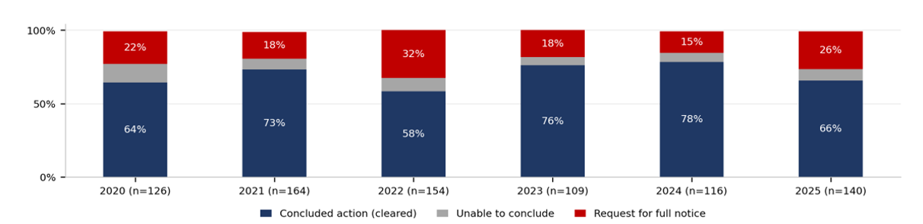
Figure 1: Declaration outcomes, 2020–2025. Source: Report, Table I-1.
This reversal may reflect the lingering effects of the appropriations lapses or a shift in the perceived risk profile of filings. Whatever the cause, parties should not assume 2024’s clearance rate will be replicated: averaging the last four years, approximately 24% of declarations resulted in a notice request.
The practical consequence is one of sequencing rather than probability. The Committee used essentially the entire assessment period in 2025, averaging 30.1 calendar days with a median of 30.0. An unsuccessful declaration therefore does not simply fail; it consumes roughly a month (plus preparation time) before the 45-day notice review begins, with a further 45-day investigation possible after that. Where timing is critical and the transaction is anything other than plain vanilla—for instance, a critical technology or sensitive data nexus, foreign government ownership, an opaque ownership chain or U.S. government contracts—it may be preferable to initiate the review by full notice rather than risk losing 30 or more days to a declaration that ends in a request for a notice. CFIUS’s new filing guidance page addresses these considerations directly and is a useful reference in making that call.
2025 Filing Volumes Rebounded Despite Operational Disruptions
In 2025, parties filed 207 notices and 140 declarations, for a total of 347 covered transactions reviewed or assessed—an increase from 325 in 2024, following two consecutive years of decline from the post-FIRRMA peak of 440 filings in 2022. As with the prior year’s downtick, the modest rebound likely has more to do with global M&A activity than with any change in CFIUS’s scope of review.
This rebound occurred despite extraordinary disruption. Three lapses in appropriations affected the 2025 reporting period: (1) a government-wide lapse from October 1 to November 12, 2025; (2) a lapse affecting Treasury and several other CFIUS member agencies from January 31 to February 3, 2026; and (3) a lapse affecting certain components of the Department of Homeland Security from February 14 to April 30, 2026. Together, these events forced the tolling of statutory case deadlines for more than 120 days in total and delayed the Committee’s ability to accept new filings. The Report acknowledges that these disruptions created uncertainty for investors and businesses that depend on a predictable review process. The Committee nonetheless cleared 67% of covered transactions within the initial assessment or review period—although that figure, like every timing metric in the Report, is calculated net of tolled days and so it may understate the transaction party experiences. Transaction timetables should account for that risk.
Timing Improved, but Lengthy Reviews Persist
The Committee continued to meet its obligations on processing timelines. For notices filed in 2025, the average time to close in review was 45.4 calendar days (median 45.0) and to close in investigation 82.8 days (median 91.0). The Committee provided comments on draft notices in an average of 5.35 business days and accepted formal notices in 3.44 business days, both within the 10-business-day benchmark.
These headline numbers mask the continuing reality that many transactions face extended timelines. Of the 207 notices filed, 114 (approximately 55%) progressed into the second 45-day investigation period, consistent with 2022–2024 and continuing a reversal of the pre-2022 trend in which most notices cleared during the initial review. Moreover, 61 notices were withdrawn, 58 after commencement of investigation; the post-investigation withdrawal rate rose to 28% from 23% in 2024, the highest withdrawal rate since 2022. Parties refiled in 51 cases (37 in 2025 and 14 in 2026), meaning those transactions faced processes well in excess of 90 days.
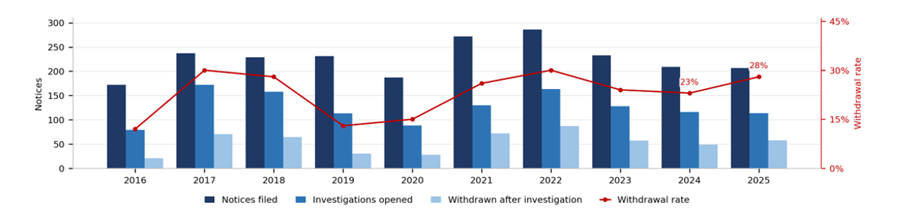
Figure 2: Notices, investigations and post-investigation withdrawals, 2016–2025. Source: Report, Table I-5.
As in prior years, parties to complex transactions should anticipate processes extending well beyond 90 days.
Mitigation Rates Continue to Decline, Signaling More Definitive Outcomes
CFIUS entered into or imposed mitigation measures or conditions with respect to 25 notices in 2025—approximately 12% of total notices—of which 15, or approximately 7%, were mitigation agreements entered on clearance. This continues a notable downward trend: in 2023, the Committee required mitigation in 35 cases, or approximately 21% of distinct transactions.
The decline is consistent with the direction set by the AFIP, which instructed CFIUS to cease using “overly bureaucratic, complex, and open-ended” mitigation agreements in favor of concrete actions that companies can complete within a specific time frame. Because the AFIP was issued in February 2025, most of the year’s caseload was reviewed after it took effect—though the trend was already visible in the 2024 data, suggesting the Committee was moving in this direction beforehand.
Meanwhile, presidential decisions were issued with respect to two transactions in 2025, which prohibited the acquisitions and required divestment. Combined with the declining mitigation rate, this may signal more binary outcomes—transactions increasingly either cleared without mitigation, were abandoned or were prohibited, with fewer resolved in the “cleared-with-mitigation” middle ground.
The Report also offers some color on how the Committee is managing its existing portfolio of agreements, which bears directly on parties already operating under mitigation. Of the 234 agreements and conditions under monitoring at year-end, 23 were terminated during 2025 while only four were materially modified. Terminations thus outpaced material modifications by nearly six to one, and the portfolio contracted on a net basis from the 242 agreements monitored a year earlier. The pattern suggests the Committee is retiring legacy obligations outright rather than renegotiating them incrementally—an approach consistent with the AFIP’s instruction to move away from open-ended agreements.
Enforcement and Non-Notified Detection Continue to Intensify
As of year-end, CFIUS was monitoring 234 mitigation agreements and conditions. Agencies conducted 40 site visits—down from 79 in 2024, likely reflecting the operational constraints of the appropriations lapses rather than a shift in compliance posture. The Committee also issued two formal determinations of noncompliance with the mandatory filing obligations and continued to investigate voluntary self-disclosures of potential filing failures. Notably, the Report does not disclose any new civil monetary penalties assessed in 2025—a contrast with the record five penalties publicly announced for 2024. The absence likely reflects these same operational disruptions rather than a retreat from enforcement.
On the non-notified front, the Committee identified thousands of potential non-notified transactions in 2025, investigated 90, opened official inquiries into 62—compared with 60 in 2023—and requested filings for nine; two additional parties filed voluntarily after receiving outreach. The Report notes that non-notified transactions remain among the most complex the Committee considers, and that it continues to enhance detection through additional staffing, new datasets and interagency coordination—building on the non-notified authorities Congress provided in FIRRMA.
Failing to file is not always a safe strategy: presidential divestment orders issued years after closing demonstrate the potential worst-case consequences of non-notification. Companies should evaluate carefully whether a mandatory filing requirement applies, and whether a voluntary filing may be prudent.
The Caseload Shifted Toward Hardware, and Allied Investors Shifted Toward Declarations
Excluding real estate filings, the 200 notices in 2025 were concentrated in Finance, Information and Services (99) and Manufacturing (79, or approximately 40%)—Manufacturing’s highest share since 2019. The movement within subsectors is more striking: semiconductor and other electronic component manufacturing accounted for 17 notices, up from four in 2024, and aerospace products and parts rose to 13 from six, while electric power generation declined to seven from 11 in 2024, and scientific research and development services held roughly flat at 12 (up slightly from 10 in 2024). Sponsors in semiconductor, aerospace and precision instrument supply chains should assume their transactions sit within the Committee’s current focus.
Investors from China again accounted for the highest number of notices, with 33 (approximately 17%), consistent with 2023 and up from 26 in 2024; over 2023–2025, China leads cumulatively with 92 notices (14%), ahead of Japan (62) and the UAE (61). The declaration program, by contrast, remains dominated by allies and partners—France, Singapore, South Korea and the United Kingdom each filed more declarations than notices, and Singapore rose from zero declarations in 2023 to 13 in 2025, while China filed five.
The “critical technology” data cut against a common assumption. CFIUS reviewed 166 covered transactions involving U.S. critical technology companies in 2025, but the leading acquirer jurisdictions were Japan (20), France (16), Israel (15) and Germany (13); China accounted for eight. In volume terms, transactions involving critical technology are overwhelmingly an allied-investor phenomenon.
Reading the Country Data: What the Report Does and Does Not Show
Chinese-investor filings remain substantial in number, but the trend line is flatter than it may first appear. Notices from Chinese acquirers totaled 33 in 2025, up from 26 in 2024 yet level with the 33 recorded in 2023; declarations rose from two to five. The three-year pattern is therefore a rebound to 2023 levels rather than a secular increase.
On how those filings fared, the Report does not disaggregate clearances, mitigation or prohibitions by acquirer country, so it cannot answer the question directly. Two indirect indicators are available. First, although Chinese investors led total notice volume, the Report identifies Japan, the UAE and Canada as the leading sources on a distinct-transaction basis—which counts withdrawn-and-refiled notices only once. That Chinese investors do not appear on that list despite leading raw volume implies their filings were disproportionately withdrawn and refiled, the pattern associated with contested reviews and protracted mitigation negotiations. Second, both presidential orders prohibiting a transaction and requiring divestment in this period involved China-controlled acquirers. The available evidence thus points toward longer and more adverse outcomes for China-related filings, but it is inferential rather than reported.
Canada, by contrast, has not seen the decline that current bilateral friction might suggest. Canadian notices rose to 15 in 2025 from 12 in 2024, approaching the 16 filed in 2023, and Canada ranks third on the Report’s distinct-transaction basis—ahead of every European filer. Canadian declarations did soften, from 13 in 2023 to 11 and then nine. Canada therefore remains the fourth-largest source of notices and among the top three sources of distinct transactions.
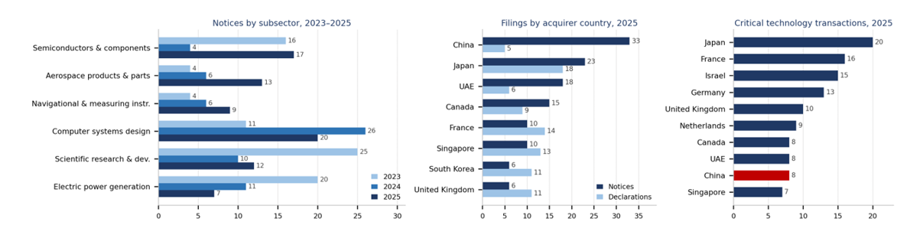
Figure 3: Notices in selected subsectors, 2023–2025 (left); notices and declarations by foreign acquirer home country or economy, 2025 (center); and covered transactions involving U.S. critical technology companies by foreign acquirer home country or economy, 2025 (right). Source: Report, Tables I-3, I-12, I-13 and II-1.
Conclusion
CFIUS’s annual reports continue to provide a useful tool for understanding the operations of a regulatory process that otherwise remains largely shrouded from public view. The 2025 Report, read alongside the launch of a modernized CFIUS.gov website and the ongoing implementation of the AFIP, shows a Committee navigating institutional evolution—balancing the administration’s stated goal of welcoming investment from allies and partners against continuing, and in some respects intensifying, scrutiny of transactions. CFIUS remains an active, well-resourced regulator that reviews hundreds of transactions per year, screens thousands for non-notified transactions and is increasingly willing to use its enforcement and blocking authorities, even as the new CFIUS.gov tools and the Known Investor Program represent genuine efforts to reduce friction for lower-risk transactions.
For the full text of our memorandum, please see:
For CFIUS’s 2025 Annual Report, please see:
Nasdaq and NYSE to Implement 23/5 Trading
On December 6, 2026, major exchanges, including Nasdaq and the NYSE (through its NYSE Arca platform), are moving to overnight, or “23/5,” trading, which will run from 9:00 p.m. Sunday through 8:00 p.m. Friday (all times are Eastern). As a result, there will be a visible price for a listed company’s stock updated throughout non-regular trading day hours.
Trading currently runs from 4:00 a.m. through 8:00 p.m. on Nasdaq and the NYSE, so this proposal is, in effect, adding an overnight session from 9:00 p.m. through 4:00 a.m. The regular trading day remains unchanged: the 9:30 a.m. “open” and the 4:00 p.m. “close” remain in effect, and closing prices will continue to be published. In addition, trading will be paused between 8:00 p.m. and 9:00 p.m. on Monday through Thursday, and from 8:00 p.m. on Friday until 9:00 p.m. on Sunday.
The rollout of overnight trading will initially include an “overnight price band” that will cap fluctuations in prices between 9:00 p.m. and 4:00 a.m. to 20% compared to the closing price and the last reported price at 7:45 p.m. such that the overnight price cannot fall more than 20% below the lower of the two reference prices, and cannot exceed the higher reference price by more than 20%.
Timing of Material News
Despite these changes, the current standard practice of releasing news after the 4:00 p.m. regular trading close, and releasing news in the morning before regular trading open, are both still viable, and the SEC staff has confirmed that they are not aiming to alter this practice.
When considering the timing of releases after market close, issuers should remember that the overnight price band is locked in at 7:45 p.m. and switches off at 4:00 a.m. If news is released before 7:45 p.m., the news will have the opportunity to impact the share price prior to the overnight price band being locked in. By contrast, the impact of news released after 8:00 p.m. will be capped by the overnight price band until the band expires at 4:00 a.m. There are no current plans for the SEC to increase EDGAR filing hours for Form 8-K or Form 6-K filings (currently from 6:00 a.m. to 5:30 p.m.).
Additional Considerations for Issuers
- Insider Trading Policy. Many policies open or close the company’s trading window based on trading In light of 23/5 trading, issuers should consider whether this language needs to be modified for clarification.
- Other Material Agreements’ Use of “Trading” Days. Similarly, issuers should revisit their material agreements to see whether they use a concept of “trading days” and, as above, consider modifying appropriately for clarification.
- Disclosure Controls and Regulation FD. Companies should consider (if not already in place) setting up an off-hours escalation protocol for rumors, leaks and unusual trading.
* * *
Related Insights

September 30, 2026
